Hydrogen flow measurement is harder than natural gas metering because of two physical properties. Hydrogen carries sound at 1,304.7 m/s at 20 °C and 0.101325 MPa, about 2.9 times faster than methane. It is also about 8 times less dense than methane under the same conditions (NIST Chemistry WebBook, accessed 2026; ratios calculated from NIST data). The first property compresses the time a sound pulse spends in the gas. The second weakens the pulse that reaches the receiver.
Ultrasonic transit-time meters can measure hydrogen when the transducers, timing electronics, and flow path are designed for these two properties. The transit-time difference is the difference between the time a sound pulse takes to travel with the flow and against it; it scales with gas velocity. This article focuses on OEM systems: PEM electrolyzers and PEM fuel cells at 1 to 20 bar, with wet and mixed gas. Pipeline, blending, and refueling metering are different problems and appear only as context.
Why is hydrogen flow measurement more difficult than natural gas?
Moving from natural gas or air to hydrogen changes what an ultrasonic meter has to resolve, and the NIST values below show by how much.
Property (20 °C, 0.101325 MPa) | Hydrogen | Methane | Nitrogen |
|---|---|---|---|
Speed of sound (m/s) | 1,304.7 | 445.01 | 349.10 |
Density (kg/m3) | 0.083752 | 0.66816 | 1.1648 |
Acoustic impedance (Rayl, calculated) | about 109 | about 297 | about 407 |
Source: NIST Chemistry WebBook. Impedance calculated as density multiplied by speed of sound.
How the speed of sound in hydrogen shortens transit times
At 20 °C, hydrogen carries sound at 1,304.7 m/s at atmospheric pressure, 1,391.5 m/s at 10.1 MPa and 1,910.3 m/s at 70.1 MPa (NIST isotherm data). A pulse crosses the same path about 2.9 times faster than in methane.
In the transit-time principle, the meter infers gas velocity from the difference between upstream and downstream travel times. A shorter travel time means a smaller time difference for each unit of velocity, so the timing electronics need finer resolution, and the receive window must open earlier to catch the pulse.
Why low density weakens the ultrasonic signal in hydrogen
Hydrogen has a density of 0.083752 kg/m3 at 20 °C, against 0.66816 kg/m3 for methane and 1.1648 kg/m3 for nitrogen. Acoustic impedance equals density times the speed of sound; it determines how much sound energy passes from a transducer into the gas. For hydrogen, it is about 109 Rayl, against about 297 for methane and about 407 for nitrogen (calculated from NIST data).
Transducers must bridge a high-impedance active material and a low-impedance gas, as Gani, O'Leary and Galbraith (IEEE Sensors Journal, 2026) describe. In hydrogen, the mismatch is larger, less energy enters the gas, and the signal-to-noise ratio (SNR: how strong the received pulse is compared with background electrical and acoustic noise) drops. The weak signal therefore starts at the transducer interface, which makes transducer design the first lever.
Temperature must be measured close to the acoustic path. Hydrogen's speed of sound rises about 2.07 m/s per K between 0 and 100 °C, against about 0.65 m/s per K for methane (both calculated from NIST data). The same temperature error changes the sound speed about three times as much in hydrogen, and every flow or composition value calculated from that sound speed carries the same error.
Hydrogen flow measurement in PEM electrolyzers and fuel cells
OEM hydrogen streams are wet and change in composition during operation, so a meter calibrated for dry, pure hydrogen reads a different gas than the one in the loop. Pressure is typically 1 to 20 bar, which lowers the density further.

Wet hydrogen at the PEM electrolyzer outlet
Water (18.0153 g/mol) is about 9 times heavier than hydrogen (2.01588 g/mol), according to NIST. Even a few percent of water vapor at an electrolyzer outlet therefore changes the mixture's molar mass and speed of sound noticeably: 5 mol% water raises the molar mass by roughly 40% (calculated, ideal mixing). In alkaline electrolysis, ultrasonic meters also work on the liquid side, where they monitor the KOH electrolyte concentration together with its flow.
H2/N2/H2O mixtures in fuel cell anode recirculation
Anode recirculation is the loop in a PEM fuel cell that returns unused hydrogen, plus nitrogen and water vapor, from the stack outlet back to the inlet. The recirculated medium becomes enriched with heavier nitrogen, which changes the mixture's properties. In one anode recirculation model, a purge starts when the hydrogen to nitrogen ratio falls below 80:20 by volume, and the mixture's specific heat capacity drops from about 9,000 to about 4,000 J/(kg·K) as nitrogen and water vapor build up (Nachtigal et al., ETC 2023).
A flow reading that assumes pure hydrogen drifts as nitrogen builds up. Tracking composition in the loop with speed-of-sound composition measurement (reading the gas mix from its speed of sound) keeps volume and mass readings valid, and signals purge timing.
Low pressure, low flow and transients in OEM systems
Low pressure lowers density and weakens coupling further. Clamp-on meters need a minimum fluid pressure about three times higher than for natural gas (Hoheisel and Schwede, GFMW 2024), so low-pressure loops call for in-line geometry designed for hydrogen.
Start-up, load steps and purges produce fast changes in flow and composition, so response time matters. Turndown, the ratio between the highest and lowest flow a meter measures within its stated accuracy, decides whether one meter covers both idle and full load. Bench-scale electrolysis and test benches add a demand for low minimum flow.
What factors affect hydrogen flow measurement accuracy?
Beyond the acoustics, four factors set the error budget of a hydrogen flow reading: gas composition, mass or volume output, the calibration route, and compensation for pressure and temperature.
Some ultrasonic models need correction for gas composition bias, according to a TÜV SÜD NEL, VSL and DNV study (Chinello et al., 2025). In tests on low-pressure gas meters for pure hydrogen, a 2% nitrogen impurity affected ultrasonic volume flow (Mussard et al., Hydrogen, 2026).
Choose mass or volume output deliberately. Volumetric flow is volume per time at line conditions; mass flow is kilograms per time and needs density, which depends on pressure, temperature and composition. Normal (standard) volume converts the reading to fixed reference pressure and temperature so values are comparable.
For comparison, OIML R 139 sets accuracy classes 2 and 4 for hydrogen dispensing systems, with a 1.5% maximum permissible error for a class 2 meter; refueling and custody transfer are separate metering problems.
Calibrating hydrogen flow meters with substitute gases
The MetroHyVe 2 Good Practice Guide (2023) states that no traceable flow calibration facilities operate with hydrogen at realistic pressures (up to 700 bar) and temperatures (-40 to 50 °C). Most meters are therefore calibrated on air, nitrogen, water, or helium. In the same guide, air and nitrogen calibration gave expanded uncertainties of 0.67% to 0.77% at lower flows, and water 0.16% to 0.42%. ISO 17025-accredited hydrogen calibration is scarce.
Matching the Reynolds number, the dimensionless ratio of inertial to viscous forces that describes the flow profile, lets a calibration on one gas transfer to another. At similar Reynolds numbers, however, hydrogen flows about 7 times faster than natural gas (Krajcin, Chudoba and Laan, GFMW 2022). Cavuoto et al. (Int. J. Hydrogen Energy, 2025) use helium as a reference fluid because its speed of sound is closer to that of hydrogen-rich gas, reaching 0.09% expanded uncertainty (k=2).
Hydrogen flow meter materials, embrittlement and ATEX requirements
Hydrogen embrittlement is the loss of ductility in some metals when hydrogen atoms enter the material, which can lead to cracking under stress. Sandia National Laboratories reports that 316 stainless steel is more resistant to hydrogen-assisted fracture than most other austenitic stainless steels. The same reference notes that resistance improves with nickel content and that embrittlement is strongest near 200 K.
Hydrogen is also a small molecule that permeates and leaks, so seals and sensor diaphragms need checking as well as the meter body. Hydrogen is a Group IIC gas, so electronics in hazardous zones need matching ATEX or IECEx certification for that group and zone.
Can ultrasonic flow meters measure hydrogen?
Ultrasonic transit-time meters measure pure hydrogen and hydrogen mixtures when transducer impedance, frequency, timing electronics, and flow path are designed for hydrogen's speed of sound and density. Each design change below answers one hydrogen-specific problem, from the weak signal to temperature sensitivity:
- Weak signal: transducers with low-impedance matching layers raise the energy that enters the gas (Gani et al., 2026).
- Crosstalk: sound that travels through the meter body or pipe wall and reaches the receiver before the pulse through the gas is handled with filters and frequency settings (Krajcin, Chudoba and Laan, GFMW 2022).
- Short transit times: fast timing electronics and early receive windows catch the pulse.
- Low pressure: a flow path geometry designed for low pressure keeps the signal usable.
- Temperature sensitivity: temperature is measured close to the acoustic path.
The method has no moving parts and negligible pressure drop in a straight bore, which matters in electrolyzers because pressure is costly to regain.
How do you measure hydrogen concentration in a gas mixture?
Speed of sound depends on molar mass through c = √(γRT/M), where γ is the heat capacity ratio, R the gas constant, T the temperature and M the molar mass. A measured speed of sound plus temperature therefore reveals the mixing ratio of a known two-gas mixture; micromachined ultrasonic transducers discriminated changes below 2 mol% of hydrogen in natural gas blends (Monsalve et al., 2024). For the three-component H2/N2/H2O gas in a fuel cell loop, a separate humidity measurement resolves the water share, and the speed of sound then gives the H2/N2 ratio.
Limits of ultrasonic flow measurement in hydrogen
Ultrasonic metering in hydrogen has five stated limits:
- Composition bias: some ultrasonic models need correction for gas composition bias (Chinello et al., 2025).
- Meters built for natural gas: in the first European intercomparison with up to 20% hydrogen, an ultrasonic meter designed for natural gas showed limited reproducibility, with a 0.50% standard uncertainty (Mussard et al., 2026).
- Calibration transfer: calibration on air, nitrogen, water or helium adds uncertainty, because no traceable flow calibration facility operates with hydrogen at realistic pressures and temperatures (MetroHyVe 2, 2023).
- Field results: a clamp-on meter overread by about 1.5% against an inline ultrasonic meter at DN250, and deviated by about 1% on average against three Coriolis meters at DN400 (Hoheisel and Schwede, GFMW 2024).
- Composition range: speed of sound gives the mixing ratio only when the gas is a known two-gas mixture.
Which flow meter is best for hydrogen gas?
No single meter type fits every hydrogen application. Coriolis meters measure mass directly and are the default for refueling, while low-pressure OEM loops often need other designs. The table compares the main types for hydrogen.
Meter type | Measuring principle | Hydrogen-specific limit | Fits OEM conditions when |
|---|---|---|---|
Ultrasonic transit-time | Time difference of sound pulses with and against the flow | Weak signal at low density, so transducers and flow path must be designed for hydrogen; composition bias in some models. | Pressure drop must stay low, flow can reverse or composition needs tracking |
Coriolis | Direct mass measurement from tube vibration | Needs a minimum density (minimum pressure) and adds pressure drop | Mass flow is required and pressure is high enough |
Thermal mass | Heat transfer to the gas | Unconfigured units erred by about +25%; configured units stayed within ±1.2% (Chinello et al., 2025) | The meter is configured for hydrogen and moderate accuracy is enough |
Differential pressure, vortex, turbine | Pressure difference, vortex shedding, rotor speed | Impractical in hydrogen: low density and, for turbine, moving parts | Rarely for OEM hydrogen |
The right choice depends on pressure, composition, whether mass or volume is needed, and the calibration medium.
Allengra Hydrogen Flow Meter for H2/N2/H2O mixtures
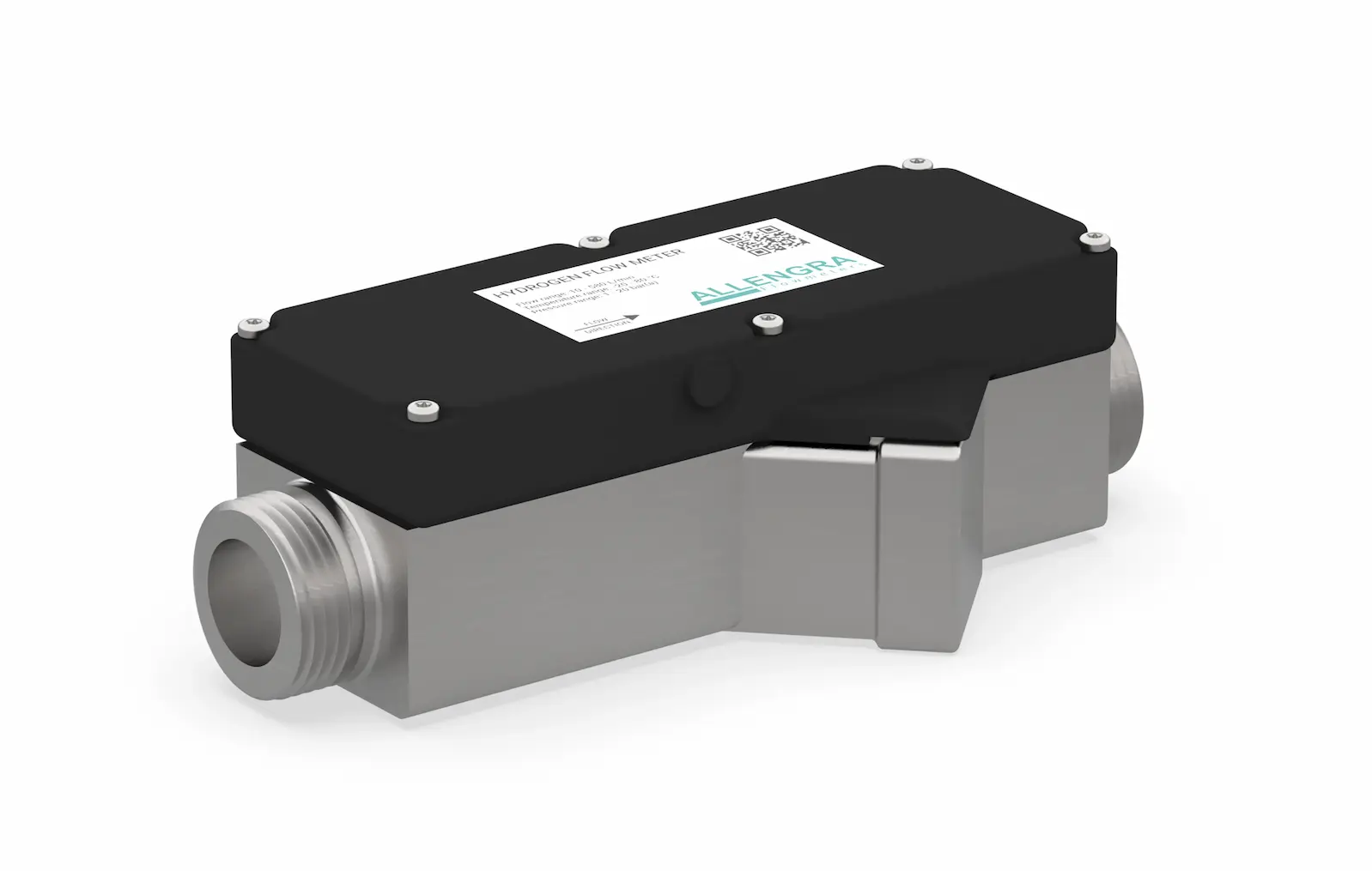
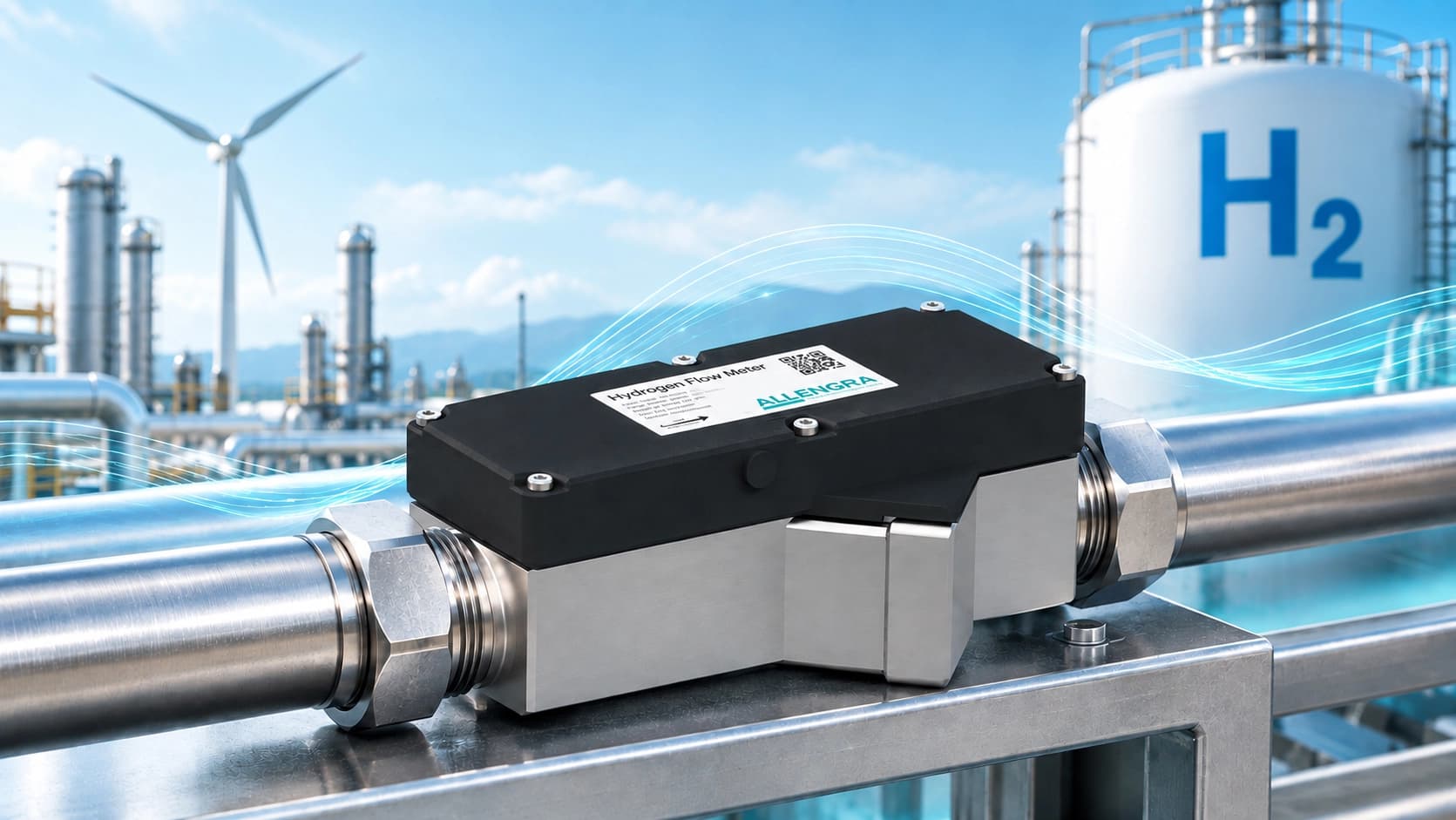
The Allengra Hydrogen Flow Meter is an ultrasonic meter for the wet, variable-composition, low-pressure hydrogen found in PEM electrolyzers and fuel cell loops. One device measures volume flow, mass flow, humidity, temperature, pressure, and H2/N2/H2O composition. Intended applications are PEM fuel cell anode recirculation, electrolyzers, fuel cell stack monitoring and test benches.

Parameter | Allengra manufacturer specification |
|---|---|
Flow range, volume | 3/4": 10 to 1000 l/min; 1": 20 to 1700 l/min (prototype); 1 1/2": 40 to 3400 l/min (prototype) |
Volume flow | ±3% of measured value |
Mass flow | ±4% of measured value |
Pressure | 0.8 to 20 bar(a) |
Temperature | -20 to 85 °C |
Humidity | 0 to 100% RH (±3%) |
Response | Volume flow and pressure below 0.5 s |
Interfaces | CAN-Bus, Modbus |
Wetted parts | 316L and silica (datasheet also lists SS 303, SS 304, photopolymer) |
Each specification maps to a hydrogen measurement problem in OEM systems:
- Humidity and composition: the humidity reading lets the meter separate water vapor from the nitrogen share in H2/N2/H2O gas.
- Pressure range: 0.8 bar(a) at the lower end covers the low-pressure loops where density is lowest.
- Response time: start-up, load steps and purges produce fast changes that a response below 0.5 s is meant to follow.
- Outputs and interfaces: mass and volume flow are both available, with CAN-Bus and Modbus for the control system.
Variants, drawings and the datasheet are on the Allengra product page for this meter, which also takes quote requests. For the cathode air side, Allengra's meter for fuel cell intake air measures humid air with the same ultrasonic method.
Measuring hydrogen flow in practice: interview with Allengra R&D
To see how these effects show up in real systems, we asked Cristian Berindea, R&D Engineer at Allengra, four questions about measuring hydrogen in practice.
1. What challenges do you face when measuring hydrogen?
The main challenges we face are related to the handling of the gas itself. Since hydrogen is stored in cylinders at high pressure (above 250 bar), the cylinders need to be secured and handled with great care when they are connected to the test bench.
Hydrogen is also a highly flammable gas, so we must take extensive safety precautions to ensure that testing and calibration can be carried out under appropriate and safe conditions.
From the perspective of implementing hydrogen into a test bench, another challenge is its low density (about 14 times lower than that of air), which makes sealing the system particularly difficult. Therefore, the sensors need to be thoroughly inspected at the welds and connection points to prevent even the smallest leaks, which could have serious consequences.
2. What other projects have our sensors been involved in, besides MiNaMi (the project developing Europe's first megawatt-scale PEM fuel cell system for shipping)?
The vast majority of the projects we are involved in, through collaborations with various companies, are focused on the development and improvement of fuel cells.
A good example is the use of our sensors in the aerospace industry, with partners such as ZeroAvia, MTU, H2Fly, and DLR. These projects focus on the development of fuel cells for aircraft propulsion, mainly involving prototypes and experimental aircraft, with the long-term goal of completely eliminating CO₂ emissions.
3. Are ultrasonic sensors the best option for hydrogen? If so, why?
In general, ultrasonic sensors are considered one of the best options for hydrogen flow measurement.
More specifically, Allengra ultrasonic sensors provide a flow measurement solution with minimal pressure loss in the system, as they have no mechanical components that obstruct the flow.
Allengra sensors can also determine the composition of the measured gases. This allows us to identify the gas mixture present in the system, as well as the relative humidity of the gas.
Ultrasonic sensors are also a scalable solution, as they can be easily adapted to different flow rates and pipe diameters.
4. Where does hydrogen flow need to be measured? What are the applications?
Our flow meters are generally used in fuel cells and electrolyzers.
In fuel cell applications, they are most commonly used in the anode recirculation loop, where the flow of unused hydrogen is measured before it is recirculated and reused to maximize system efficiency.
In this case, the hydrogen purity, gas composition, and humidity can also be measured. This information helps determine how efficiently the system is operating, including how effectively it separates and manages the water vapor present in the system.
Examples of applications include:
● Backup power for data centers and hospitals: fuel cell systems from Ceres Power provide a reliable and continuous power supply without depending on the local electricity grid.
● Hydrogen electrolysis: measuring the flow rate and quantity of hydrogen produced through water electrolysis.
● Electricity generation using fuel cells: for industrial applications in remote areas without reliable access to electricity, generally for small- to medium-scale production and mining operations. In some cases, fuel cells are also used for heating as a by-product of electricity generation, increasing the overall efficiency of the system by making use of the thermal energy instead of wasting it.
● Transportation industry: hydrogen fuel cell systems are not yet used on a large scale, but they are already being implemented in buses, trucks, and passenger vehicles.
Hydrogen flow measurement best practices: OEM specification checklist
Use this checklist in a datasheet request or design review.
Item | What to ask for | Why it matters for hydrogen |
|---|---|---|
Gas composition | H2/N2/H2O range and purge thresholds | Sound speed and density change with mixture |
Humidity | Range; measured or compensated | Water is about 9 times heavier than hydrogen |
Operating pressure | Range and the meter's minimum pressure in hydrogen | Low density weakens the signal |
Temperature | Range and sensor position relative to the acoustic path | Sound speed rises about 2.07 m/s per K |
Flow range | Turndown from idle to full load | One meter must cover both |
Response time | Figure for start-up and purge events | Transients change flow and composition fast |
Output | Mass flow, volume flow or normal volume | Mass needs density |
Calibration | Medium and stated uncertainty | Substitute gases add uncertainty |
Wetted materials | Steel grade, seals, transducer material | Embrittlement and permeation |
Hazardous area | ATEX or IECEx, Group IIC, zone | Hydrogen is flammable |
Interfaces | CAN-Bus, Modbus or other | Integration with the control system |
Installation | Straight runs, purging, maintenance | Affects readings and service |
To discuss a specific system, request a quote from Allengra with the completed checklist attached.