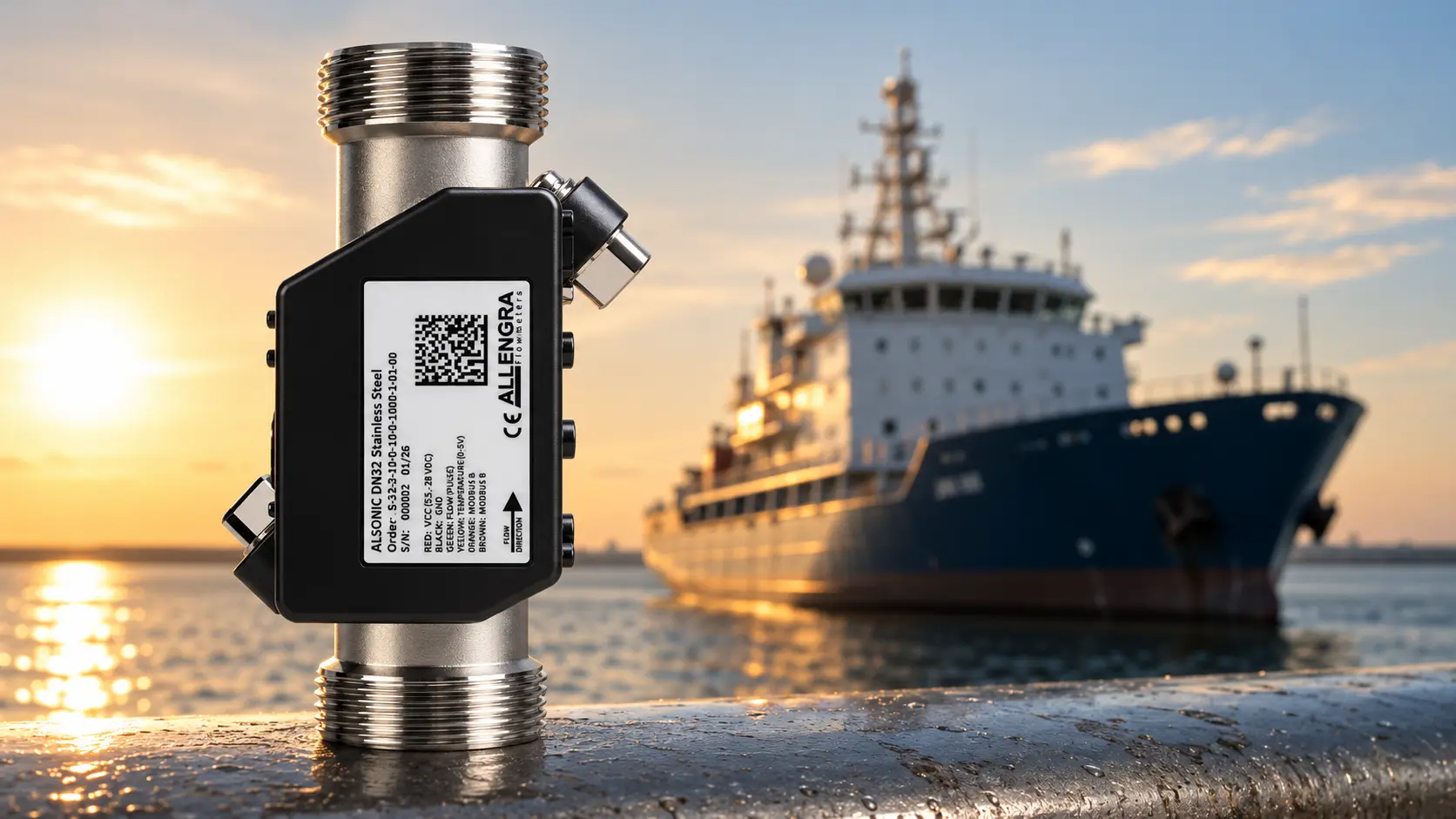
Walk into the engine room of most commercial vessels, and you'll find valves, gauges, and pipework built to survive decades of hard use. What you often won't find is a clear, real-time answer to a simple question: how much fluid is actually moving through any given line right now? Fuel, coolant, ballast water, freshwater. On a ship, nearly every system depends on liquid moving where it should, at the rate it should. Ultrasonic flow meters have quietly become one of the more practical ways to answer that question, and shipowners and OEMs are paying attention.
This article looks at where ultrasonic flow measurement is already proving itself on board: fuel monitoring and contamination detection, engine cooling, and the wider category of onboard liquid management that covers ballast water, freshwater production, and hydraulic systems. It also touches on the other flow meter technologies still used across the industry and where each one tends to make more sense.
Keeping Tabs on Fuel: Consumption, Contamination, and Cost
For most vessels, fuel is the single largest line item in the operating budget. That alone makes it worth measuring properly. Ultrasonic flow meters installed on the fuel supply line provide the crew with real-time consumption data, visible on the bridge or fed directly into the vessel's management system. Instead of estimating burn rate from tank soundings once a shift, engineers can watch consumption per voyage leg, per engine, or per speed setting, and catch a deviation the moment it happens rather than after the fact.
For engines with a return line, which covers a large share of marine diesels, a differential measurement setup solves a problem single-point meters can't. Two meters (one on the supply line, one on the return) or a single differential unit reads both lines and works out the actual net consumption as the difference between them:
The supply meter records how much fuel leaves the tank.
The return meter records how much comes back unburned.
The difference between the two is what the engine actually consumed, regardless of how much fuel is circulating through the injectors at any moment.
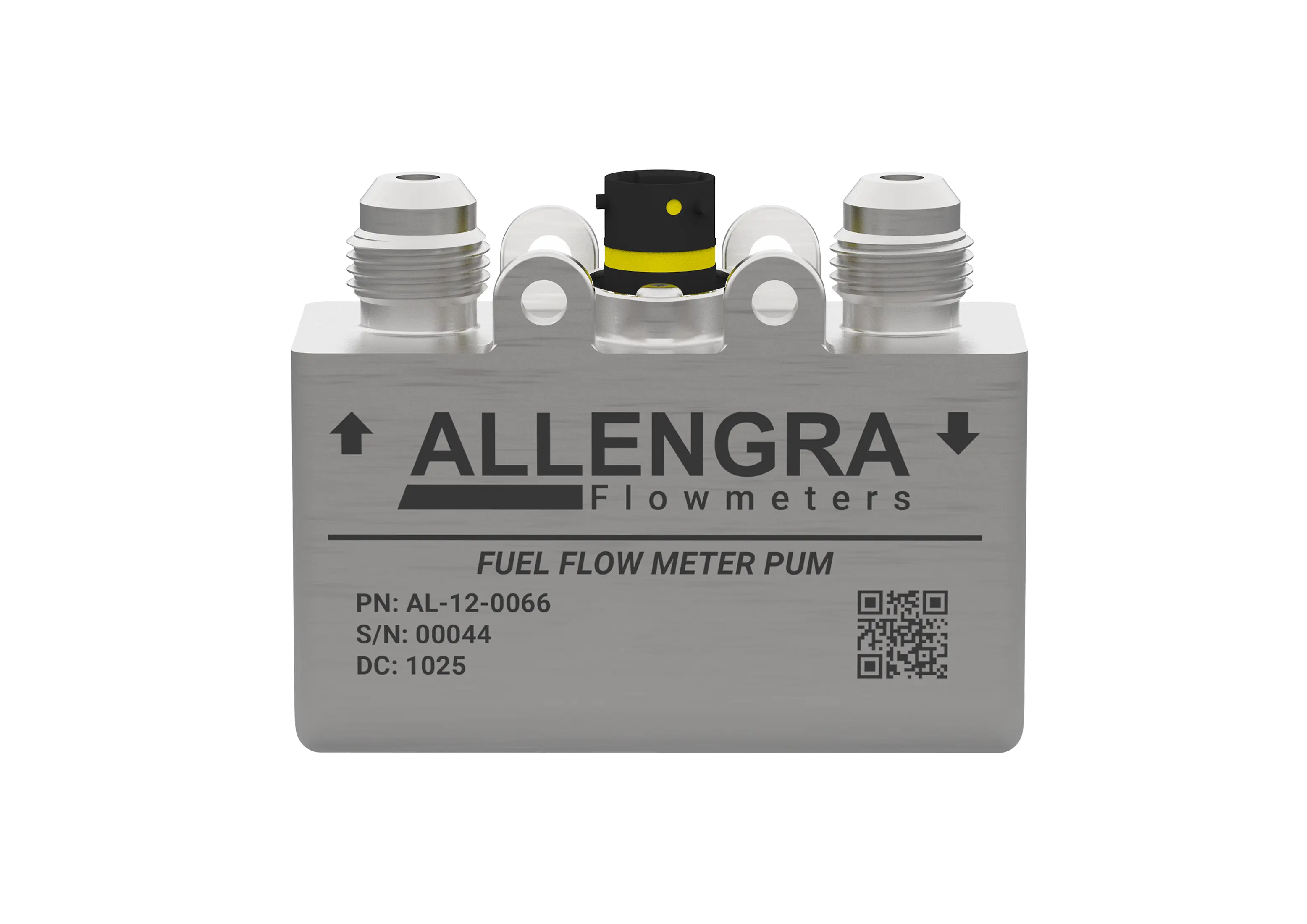
Allengra's differential fuel flow meter, originally developed for motorsport and automotive applications, is built around exactly this kind of setup, with a flow range up to 1,500 l/h and accuracy within half a percent of the measured value. That tolerance says a lot about how far the underlying technology has been pushed.

There's a second benefit that doesn't need any extra hardware at all. Ultrasonic meters calculate flow using the speed of sound through the fluid, and that speed happens to be sensitive to the fluid's composition. When fuel gets contaminated with water or adulterated during bunkering, the speed of sound reading shifts away from what's expected for that fuel type. The meter is already generating this data as part of its normal operation, so fuel quality and contamination detection come essentially free with the flow measurement. No separate sampling kit, no lab turnaround time. Given how often bunkering disputes come down to arguments about fuel quality after the fact, having that data logged automatically is worth more than it might first appear.
Engine Cooling: Where Ultrasonic Sensors Already Earn Their Keep
If fuel monitoring is the newer application, engine cooling is where ultrasonic flow measurement has had time to prove itself. Continuous monitoring of the cooling circuit means a flow drop, whether from a failing pump, a blockage, or a slow leak, triggers an alarm before engine temperature reaches a critical point. That matters more than it might sound, especially in unmanned engine rooms, which are becoming standard on modern vessels. Nobody's standing there watching a gauge; the system has to catch the problem on its own.
The same sensors also read glycol concentration in the coolant, derived from the speed of sound in the mixture, so antifreeze protection can be verified without draining the loop or pulling a manual sample. On a vessel where every hour in the engine room competes with a dozen other maintenance tasks, that's not a small convenience.
Why has this particular application matured faster than others? Partly because the underlying technology has already been tested for years in demanding stationary systems, and the results hold up well. In independent field testing on heating installations, sensors pulled after seven years of continuous operation still matched their original end-of-line calibration values, with no measurable drift and no meaningful buildup on the sensor surface despite years of exposure to unfiltered, particle-laden water. That kind of durability record matters on a vessel, where a failed sensor usually means a shipyard visit rather than a five-minute swap.
A few design traits explain why:
No moving parts in contact with the fluid, so there's nothing to mechanically wear out
A self-cleaning effect from micro-vibrations on the sensor surface, which keeps it working in dirty water without maintenance
Virtually no pressure loss through the sensor, so the cooling pump doesn't have to work harder to compensate for the meter itself
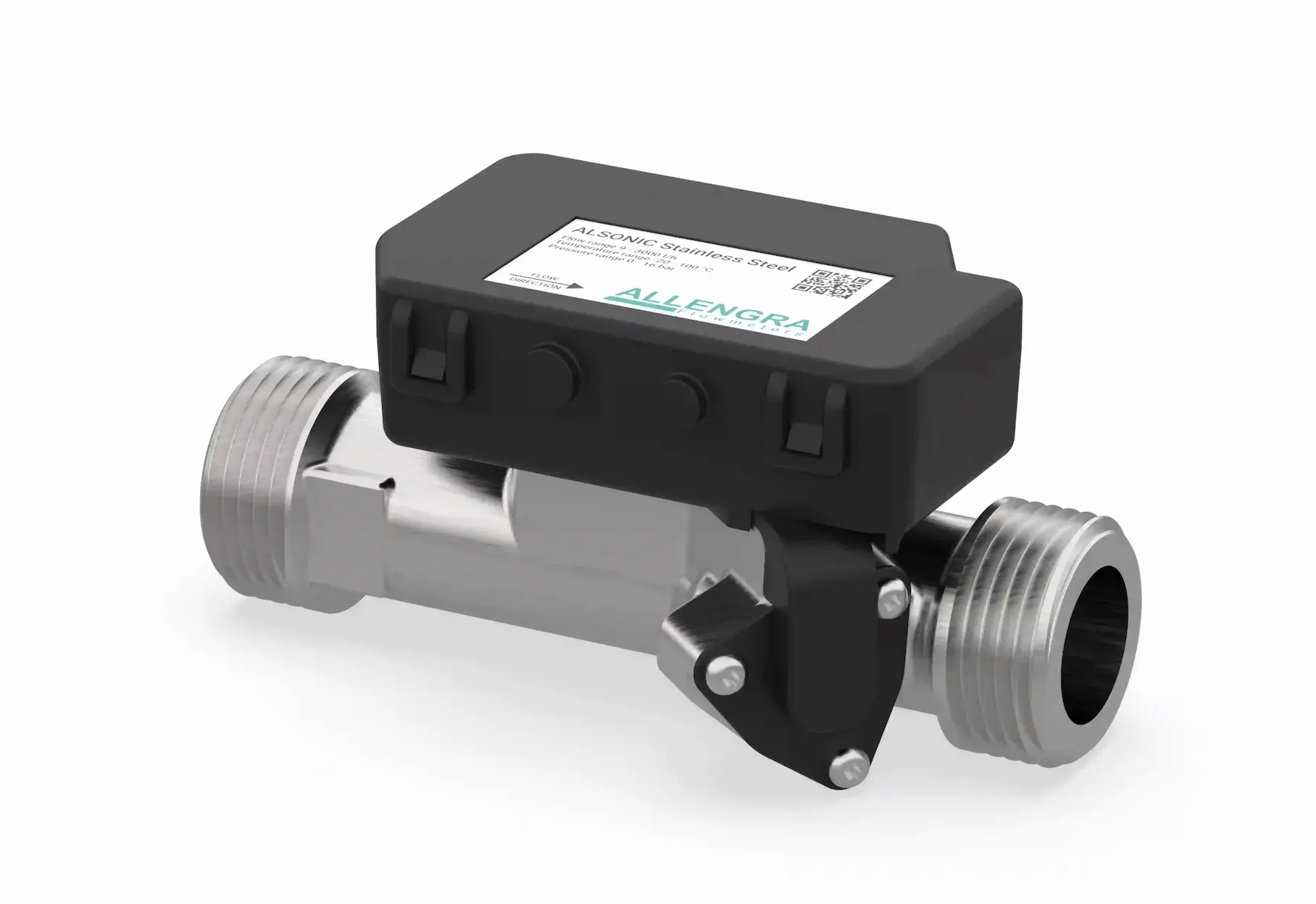
Accuracy in standard applications runs around 2 to 3 percent of the measured value across a wide flow range, with sub-0.25 percent achievable where it's genuinely needed. Products such as Allengra's ALSONIC stainless steel meter are rated for water, water-glycol mixtures, and oil at pressures up to 16 bar and temperatures from -20°C to 100°C, which is a fairly wide operating envelope for a single sensor. Pair that with a typical dynamic range (turndown ratio) of up to 1:5000, and one meter can cover both idle-speed trickle flow and full-load flow without swapping hardware, something mechanical meters generally can't manage.
Onboard Liquid Management: Ballast, Freshwater, and Hydraulics
Beyond the engine, a vessel is really a network of fluid systems, and several of them benefit from the same non-invasive measurement approach.
Ballast water is the clearest regulatory case. Flow meters installed on the ballast lines produce accurate volume records for every exchange or treatment cycle, and that documentation is exactly what's expected during port state control inspections. It's not only about staying out of trouble, either. Knowing precisely how much water moved during ballasting helps optimize the process itself, which can shave time off operations spent at anchor or adjusting trim in port.
Freshwater production and distribution are another natural fit, particularly for vessels running reverse osmosis systems to convert seawater. Metering the output of the RO unit matters both for operational planning and for confirming the system is keeping up with demand, and metering the distribution lines shows exactly where that water is going once it's made. Because these sensors have no moving parts in contact with the water, there's no risk of contaminating drinking water with wear particles or lubricant, which is exactly the kind of thing nobody wants to explain during a health inspection.
Hydraulic systems get a less obvious but genuinely useful application: leak detection. Install one meter on the pressure side of a hydraulic circuit and another on the return side, then compare the readings. If more fluid leaves the pump than comes back through the actuators over time, something inside the system is bypassing internally rather than doing useful work. Catching that early means the worn component gets replaced during a scheduled stop instead of failing mid-voyage, under load, at the worst possible time.
Where Other Flow Meter Types Still Fit In?
Ultrasonic technology hasn't replaced everything else on a ship, and it isn't trying to. A few other types remain common, each for a reason worth understanding.
Mechanical and turbine meters are the old standby: simple, well understood, and inexpensive up front. Their weakness is exactly what ultrasonic avoids. Moving parts wear, viscosity changes throw off calibration over time, and dirty fuel or water accelerates the process, still working with legacy general service water, lube oil, and fuel transfer lines on older vessels where retrofitting isn't a priority.
Positive displacement meters, the gear and piston types that physically trap and release small volumes of fluid with each cycle, remain popular where precise delivery matters more than anything else. They're mechanically simple and highly repeatable, but the same wear-and-tear problem applies over a long service life, still working with small-batch precision jobs like lube oil dosing, chemical injection, and additive metering.
Coriolis meters occupy a different niche entirely. Rather than inferring volume, they measure mass directly, which makes them largely immune to changes in fuel viscosity or density. That's a real advantage in official bunker custody-transfer metering, where a supplier and a buyer both need a number neither side can dispute, and where volumetric mismeasurement during bunkering has been linked to real financial losses on either side of the transaction. The trade-off is size, weight, and cost. Coriolis meters tend to be bulkier and pricier than a clamp-on ultrasonic unit, which is part of why ultrasonic wins out for day-to-day consumption monitoring rather than formal custody transfer.
Magnetic (electromagnetic) meters round out the list, but they only work with electrically conductive fluids, which rules out fuel and oil entirely. On board, they show up mainly in water-based applications rather than anywhere near the fuel system.
Is Ultrasonic the Right Fit for Your Vessel?
None of these technologies is universally "best." The right choice depends on what's being measured, how precise the reading needs to be, and whether physical wear or fluid contact is a genuine concern. For fuel monitoring, engine cooling, and the broader category of onboard liquid management, though, ultrasonic flow meters keep showing up as the practical answer: no moving parts to maintain, no meaningful pressure drop to fight, and data that's already being generated, whether that's consumption, contamination, or coolant condition.
Allengra designs and manufactures its ultrasonic flow meters in-house, with the flexibility to build wetted solutions for specific marine applications and OEM requirements. For vessels and fleet operators evaluating flow measurement upgrades, the marine flow meters page is a reasonable place to start.