On-board fuel consumption monitoring (OBFCM) in the EU
On-board fuel consumption monitoring (OBFCM) is the software or hardware function that determines, stores, and makes available a vehicle's lifetime fuel use, electric energy use, and distance, as Article 4a of Regulation (EU) 2017/1151 requires. Every new passenger car and N1 class I van registered in the EU since 1 January 2021 that runs on petrol, diesel, or ethanol, plug-in hybrids included, carries it, and new trucks and buses follow from 1 July 2027 under Implementing Regulation (EU) 2025/2161.
The values come from the engine control unit's calculation of injected fuel, and no separate meter is involved. This page explains the rules, the stored parameters, the data path, the accuracy checks, and where fuel flow meters come in.
What is OBFCM?
OBFCM stands for on-board fuel and/or energy consumption monitoring. The law defines an OBFCM device as "any element of design, either software and/or hardware", that senses vehicle, engine, fuel, and energy parameters and stores lifetime totals on board. Since Regulation (EU) 2023/443, that definition stands in Appendix 5 of UN Regulation No 154, to which Annex XXII of Regulation (EU) 2017/1151 now points. Engineering documents also say OBFCM device, lifetime counters, or OBFCM data, and an on-board fuel consumption meter in those texts means an ECU function rather than a fuel-line instrument.
Regulators use OBFCM data for these documented purposes:
The European Commission monitors how far real-world fuel use and CO2 emissions of cars and vans lie above the WLTP type-approval values, under Article 12 of Regulation (EU) 2019/631.
The Commission must report by 31 December 2026 on a method to adjust manufacturers' CO2 averages from 2030 with OBFCM data.
For trucks and buses, the data checks how representative the simulated VECTO values are.
Which vehicles are affected by the OBFCM rules?
OBFCM applies to cars, vans, and N2 vehicles under the light-duty Euro 6 rules that run on liquid fuels or as plug-in hybrids, and from 2027 to trucks and buses:
Vehicle category | Fuels or powertrains | Legal act | Start date |
|---|---|---|---|
M1 and N1 class I, new types | Mineral diesel, biodiesel, petrol, ethanol, OVC-HEV | Regulation (EU) 2017/1151 | 1 January 2020 |
M1 and N1 class I, all new vehicles | Same as above | Regulation (EU) 2017/1151 | 1 January 2021 |
N1 class II and III | Same as above | Regulation (EU) 2017/1151 | New types 2021, all new vehicles 2022 |
N2 (Euro 6e) | Same as above | Regulation (EU) 2023/443 | New types 1 September 2023, all new vehicles 1 September 2024 |
Light-duty BEV, natural gas, LPG | Outside the rule | Regulation (EU) 2017/1151 | Not covered |
M2, M3, N2, N3 (heavy-duty) | Listed fuels, electric, fuel cell hybrid | Implementing Regulation (EU) 2025/2161 | 1 July 2027; further combinations 29 May 2029 |
The car and van dates come from Regulation (EU) 2018/1832, which inserted Article 4a; OVC-HEVs (off-vehicle charging hybrids, or plug-in hybrids) are in scope, and NOVC-HEVs (self-charging hybrids) count as combustion vehicles. Class II and III vans joined a year later, so early datasets contain few vans. Small volume manufacturers are exempt from Article 4a. Euro 7, Regulation (EU) 2024/1257, requires OBFCM devices in all M and N vehicles and applies to new car and van types from 29 November 2026 and to all new cars and vans from 29 November 2027.
How does on-board fuel consumption monitoring work in modern vehicles?
On-board fuel consumption monitoring works by accumulating the fuel quantity that the engine control unit (ECU) already calculates for injection. The regulation defines "Total fuel consumed (lifetime)" as the accumulation of the calculated amount of fuel injected into the engine and into the pollution control device (UN Regulation No 154, Appendix 5, paragraph 2.5), and paragraph 4.1 asks for the most accurate values that the ECU's measurement and calculation system can achieve.
For vehicles other than OVC-HEVs, the OBFCM device determines these parameters:
Parameter | Unit | Vehicles |
|---|---|---|
Total fuel consumed (lifetime) | litres | All in scope |
Total distance travelled (lifetime) | kilometres | All in scope |
Engine fuel rate | g/s and l/h | All in scope |
Vehicle fuel rate | g/s | All in scope |
Vehicle speed | km/h | All in scope |
Fuel and distance in charge-depleting and charge-increasing operation | litres, kilometres | OVC-HEVs only |
Total grid energy into the battery (lifetime) | kWh | OVC-HEVs only |
The lifetime counters, values accumulated since the vehicle was produced, are preserved once the vehicle is in service (paragraph 5.2). The list has no reagent value, so OBFCM does not monitor AdBlue consumption.
What hardware does OBFCM need in the vehicle's ECU?
OBFCM needs no hardware beyond the ECU: the regulation allows software and/or hardware, and the ECU has the injection data. Two parameters split that data. Engine fuel rate is the fuel injected into the engine per unit of time; vehicle fuel rate also counts fuel injected into the exhaust after-treatment. A 2021 truck study by the International Council on Clean Transportation (ICCT) describes the ECU value as computed from injector actuation, with an accuracy that depends on the ECU's computing capability.
For trucks and buses, Implementing Regulation (EU) 2025/2161 adds on-board mass monitoring (OBMM), the part of the device that determines total vehicle mass, and requires lifetime counters in NVRAM that no scan tool command, battery disconnection, or reprogramming can erase.
OBFCM vs the standard trip computer
OBFCM stores regulated lifetime totals that cannot be reset once the vehicle is in service, and the manufacturer must make them available through the OBD port for readout. A trip computer shows the driver a consumption figure that the driver can reset at any time, and no regulation defines how it is calculated.
What accuracy standards apply to OBFCM data?
For cars and vans, the OBFCM value for "Total fuel consumed (lifetime)" over the first WLTP Type 1 test, the lab chassis-dynamometer emissions test of the WLTP procedure, must agree with the fuel consumption calculated from that test's emission results within -0.05 and +0.05 (UN Regulation No 154, Appendix 5, paragraph 4.2). OVC-HEVs use the charge-sustaining Type 1 test. If the first test misses the band, the manufacturer may accumulate up to 3 tests, or 6 with the interpolation method.
That rule covers the lab test only, and no real-world accuracy requirement exists for cars and vans. A Joint Research Centre study of 15 light-duty and 12 heavy-duty vehicles found that most met plus or minus 5 percent over complete WLTP tests or complete on-road trips, and that OBD distance stayed within plus or minus 1.5 percent of GPS for most vehicles. Trucks and buses face wider, test-specific bounds, set out below.
How is OBFCM data transmitted to the European Commission?
OBFCM data reaches the European Commission and the European Environment Agency (EEA) through two collection routes and one annual report, set out in Implementing Regulation (EU) 2021/392:
Manufacturers collect the data and the VIN of new cars and vans registered from 1 January 2021, over the air or through authorised dealers and repairers at service visits, read out free of charge through the OBD port.
Member States collect the data at roadworthiness tests with effect from 20 May 2023, read out with a scan tool, under Article 10 and Directive 2014/45/EU.
Both report to the Commission and the EEA each 1 April, starting in 2022.
The Commission publishes anonymised and aggregated data each year from December 2022, and may use the data only for the purpose of Article 12 of Regulation (EU) 2019/631.
The published real-world dataset, the anonymised OBFCM data released each year, names no vehicle; the first Commission report based on it came out on 18 March 2024.
Can car owners opt out of OBFCM data collection?
Yes. Collection by manufacturers and at roadworthiness tests goes ahead unless the owner "expressly refuses", under Articles 9 and 10 of Implementing Regulation (EU) 2021/392. The VIN travels with the data, and the regulation names the data controllers for the purposes of the GDPR. Each vehicle's data is collected for at most 15 years, and the EEA keeps VINs and data for 20 years from the first upload.
OBFCM vs WLTP: what the real-world data shows
OBFCM data shows that petrol and diesel cars use about 20 percent more fuel on the road than their WLTP values, and that plug-in hybrids reach about 3.5 times their type-approval values. The first Commission report of 18 March 2024 measured 1 to 1.5 l/100 km extra for cars registered in 2021, with these shares:
Dataset | Petrol | Diesel |
|---|---|---|
2021 data (report of March 2024) | 23.7 % | 18.1 % |
2022 data, 2021 registrations (July 2024) | 19.8 % | 18.2 % |
Plug-in hybrids reached 3.5 times their type-approval values in both datasets. The reason is the utility factor, the share of distance a plug-in hybrid is assumed to drive electrically in the type-approval calculation: drivers who rarely charge burn fuel that the formula assigns to battery driving. The EEA dataset for the reporting year 2024 covers 9,923,272 vehicles after cleaning, from 58 manufacturers and 22 Member States. These figures feed the CO2 monitoring of Regulation (EU) 2019/631, which sets CO2 targets for new cars and vans.
The next steps for OBFCM data: the 2026 report and the 2030 mechanism
Article 12(3) of Regulation (EU) 2019/631, as amended by Regulation (EU) 2023/851, sets the deadline: by 31 December 2026, the Commission must publish a report on a method that uses OBFCM data to adjust each manufacturer's average specific CO2 emissions from 2030. The utility factor revision of Regulation (EU) 2023/443 takes effect in two steps, from 2025 and from 2027, so plug-in hybrids approved after those dates carry type-approval values calculated with the revised factor.
OBFCM for trucks and buses from 2027
Implementing Regulation (EU) 2025/2161, adopted on 27 October 2025 and in force since 20 November 2025, requires OBFCM devices in newly registered M2, M3, N2, and N3 vehicles from 1 July 2027, with further fuel and propulsion combinations from 29 May 2029. Unlike the car rules, it covers pure electric and fuel cell hybrid vehicles. Heavy-duty CO2 values come from VECTO, the Commission's simulation tool for heavy-duty CO2 emissions and fuel consumption, and OBFCM data checks how representative they are on the road.
Each heavy-duty test has its own accuracy bounds for fuel consumption:
Test | Fuel consumption bounds |
|---|---|
WHTC, WHSC, FCMC | -0.10 to +0.05 |
PEMS (portable emissions measurement system) | -0.15 to +0.10 |
VTP (on-road verification testing procedure) and battery durability | -0.15 to +0.075 |
Distance in PEMS, VTP, and battery durability tests | -0.05 to +0.05 |
A value outside the bounds leaves the regulatory test result unchanged. It can, however, trigger an accuracy verification test on 3 to 8 vehicles of the family, in which the actual fuel mass is measured on board with a device as set out in point 5.7 of Annex Xa to Regulation (EU) 2017/2400. Small volume manufacturers, some M2 and N2 vehicles up to 7.5 tonnes with an alternative approval, Euro 7ext vehicles, and off-road and special purpose vehicles are exempt.
Fuel consumption flow measurement in OBFCM verification
A fuel flow meter enters OBFCM work in three places:
Truck verification tests. The truck fuel consumption meter must report total fuel in kilograms, by mass or by volume with thermal-expansion correction, with an accuracy below 1.0 percent of reading or 0.5 percent of the maximum calibration, whichever is larger, and a rise time of 2 s or less (Regulation (EU) 2019/318, Annex Xa to Regulation (EU) 2017/2400).
Car accuracy research. A 2022 ICCT study fitted ultrasonic fuel flow meters in the supply line from tank to engine; a car with a return line could not be measured that way.
R&D. Prototype and injector-level tests compare ECU values with measured flow.
Each measuring principle has its own limit for in-vehicle use:
Mechanical: moving parts that wear and react to vibration.
Vortex: needs a minimum flow to form vortices.
Delta pressure: adds a pressure drop to the fuel line.
Coriolis: size and weight suited to a test bench.
Ultrasonic: no moving parts and no obstruction, but the highest accuracy needs calibration per fuel.
Fuel consumption monitoring with Allengra fuel flow meters
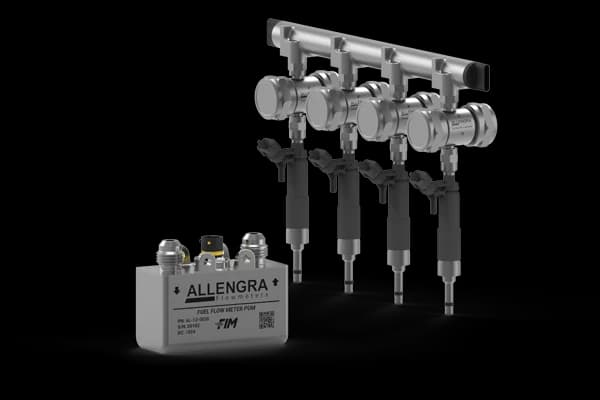
Allengra builds ultrasonic time-of-flight fuel flow meters for OBFCM verification, WLTP and RDE test work, R&D, and injector-level measurement. Allengra describes the principle as non-intrusive, with no moving mechanical components.
Product | What it measures | Key specifications that Allengra states |
|---|---|---|
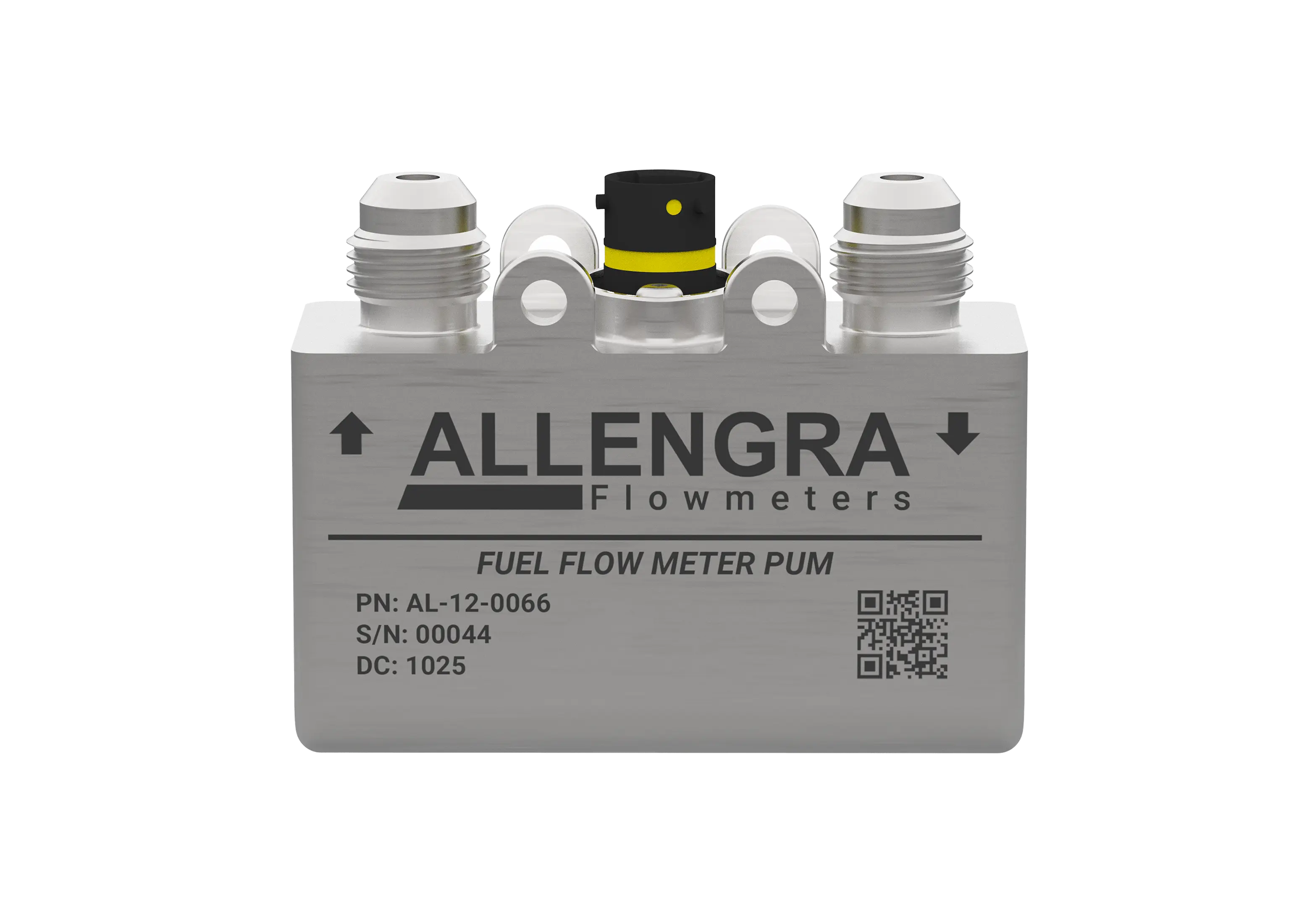
PUM Fuel Flow Meter | Fuel flow on board, WLTP on-board testing | ±0.5 % of measured value; 0.3 to 480 l/h; 0 to 90 °C; 4 to 6 kHz; CAN-Bus and Modbus |
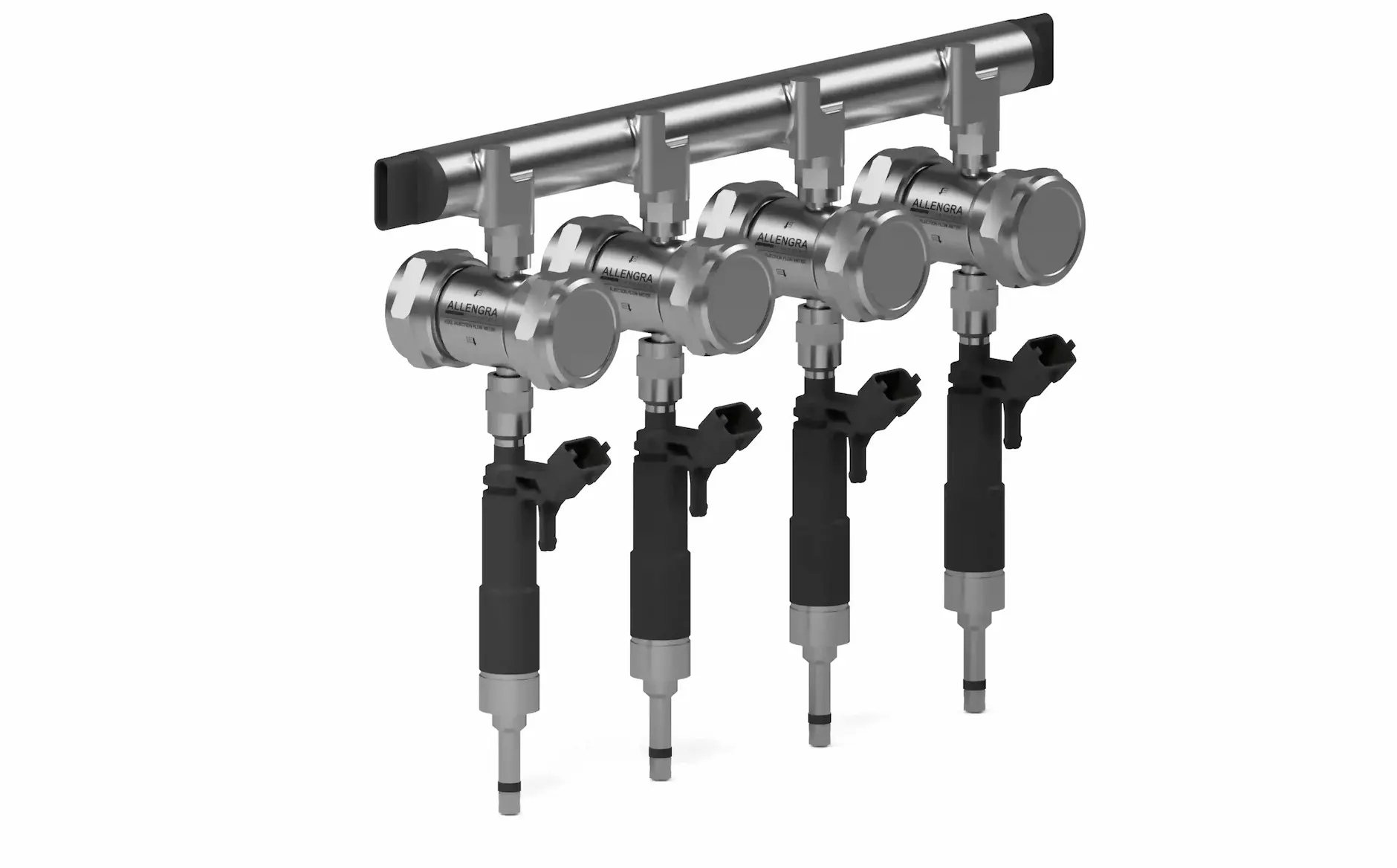
Real-Time Fuel Injector Visualization and Correction Kit | Flow at each injector | ±0.5 % of measured value; 5 to 1500 l/h; 100 kHz |
Differential Fuel Flow Meter | Supply and return line together | Integrates supply and return line metering |

(PUM Fuel Flow Meter)
Across its fuel flow meters, Allengra specifies a medium temperature range of -40 °C to 100 °C, flow from 0 to 8000 ml/min, measurement frequencies up to 1 kHz, 6 kHz for motorsport, and 100 kHz at the injector level, up to 32 measurement channels, accuracy below 0.5 percent with fuel-specific calibration, and vibration resistance according to ISO 16750 and IEC 60068. For mounting close to the engine, Allengra specifies ambient temperatures from -40 °C up to 125 °C, and its systems either use a fuel-specific calibration or compensate through built-in fuel identification, because fuel grade, temperature, and pressure affect the reading. Allengra lists ICE development, university research, injection monitoring, e-fuel evaluations, heavy-duty vehicles, and drones among the fields where its meters are used.
Allengra announced on 7 November 2024 that the FIA had selected it as the sole supplier of the Formula 1 Fuel Flow Meter and sole calibration facility for 2026 to 2030. To discuss a verification or test setup, contact the Allengra team.