Why is cooling so important when it comes to the automotive industry?
In today’s fast-paced world, every single company is looking for solutions to improve sustainability, performance, and the amount of data they can gather in order to get the most out of an engine, transmission, or cooling system.
Today, we are going to elaborate on the importance of cooling in daily-driven cars, street performance cars, and even race cars by dividing it into two main sectors: the first one being performance, and the second one, efficiency.
When we talk about performance, the major factor is the temperature. To get the best performance out of an engine, the most horsepower, etc., Temperature should be balanced, and the cooling system should maintain that exact temperature without sacrificing another key aspect, the efficiency.
Efficiency plays a pivotal role in all of this cooling domain because OEM producers need to calculate the amount of liquid needed in every moment of the cooling process in order to obtain good fuel consumption, great performance, and so on.
Also, nowadays governments are applying more and more regulations and sanctions, so the cars are getting more complicated in order to get cleaner and in the perfect balance of power and pollution.
At the same time, technology evolves faster every day, and companies start developing high-tech sensors in order to respect all the regulations when it comes to carbon dioxide and city pollution levels affected by cars.

Types of cooling in the automotive industry
1. Air cooling.
Starting off with the most common and old technique, air cooling is quite simple but not very efficient in this day and age because it struggles with thermal uniformity. Air-cooled engines rely on heat transfer directly from engine components to ambient air; airflow (natural or fan-forced) removes heat via convection. Mostly used in classic cars.
2. Liquid cooling
Following one of the most popular cooling techniques, in a liquid-cooled system, a coolant circulates through internal channels in the engine block and cylinder head, absorbing heat from the metal surfaces. This heated coolant is then routed to a radiator, where it flows through thin tubes surrounded by fins. Air passing through the radiator removes the heat from the coolant, which is then recirculated back into the engine.
The system continuously transfers heat from the engine to the air, but indirectly through the liquid medium.
3. Oil cooling
Oil cooling works by using the engine oil itself as a heat carrier. As oil circulates through the engine, it absorbs heat from moving parts such as pistons, bearings, and the crankshaft. The hot oil can then pass through an oil cooler, where it transfers heat either to air or to the engine’s coolant. This helps reduce the temperature of critical internal components while maintaining proper lubrication.
4. Intercooling
In turbocharged engines, incoming air is compressed, which raises its temperature. An intercooler cools this compressed air before it enters the engine. The hot air flows through the intercooler, where heat is removed either by ambient air (air-to-air) or by a liquid circuit (air-to-water). By lowering the air temperature, the air becomes denser, allowing more oxygen into the combustion chamber and improving efficiency and power.
5. Battery cooling
Battery cooling systems manage the temperature of battery cells by removing excess heat during charging and discharging. In liquid-cooled systems, coolant flows through channels or plates in close contact with the battery cells, absorbing heat and carrying it away to a heat exchanger. The goal is to keep all cells within a narrow and uniform temperature range in order to extend the battery’s life.
Key Components
· Cooling plates/channels – in contact with battery cells
· Coolant loop (or air ducts) – removes heat from battery
· Electric pump – circulates coolant
· Chiller (linked to A/C) – enables active cooling below ambient
· Temperature sensors – monitor each module/cell group
· Thermal control unit (ECU logic)

Challenges in cooling
The biggest challenge the automakers face these days when it comes to cooling is managing increasing heat loads in increasingly complex systems without sacrificing efficiency, safety, or reliability.
The reason is quite easy to understand, because of the new regulations and limits imposed by the governments, automakers are downsizing turbocharged engines, which create higher thermal stress and overcomplicate the emission systems, which add additional heat sources.
Efficiency is also a problem because overcomplicated systems tend to use more and more energy.
Safety can be compromised by an EV battery fire or an engine overheating
Reliability expectations lowered because of many heat cycles and pressure
Regulations need to be respected because cooling directly impacts fuel efficiency, emissions, and the warm-up time
One system is no longer enough, with many types of cooling systems in one car and many different fluids cooling different parts of the car.
All of this leads to one fundamental engineering conflict: You need more cooling capacity, but you can’t afford more energy, space, cost, or complexity.

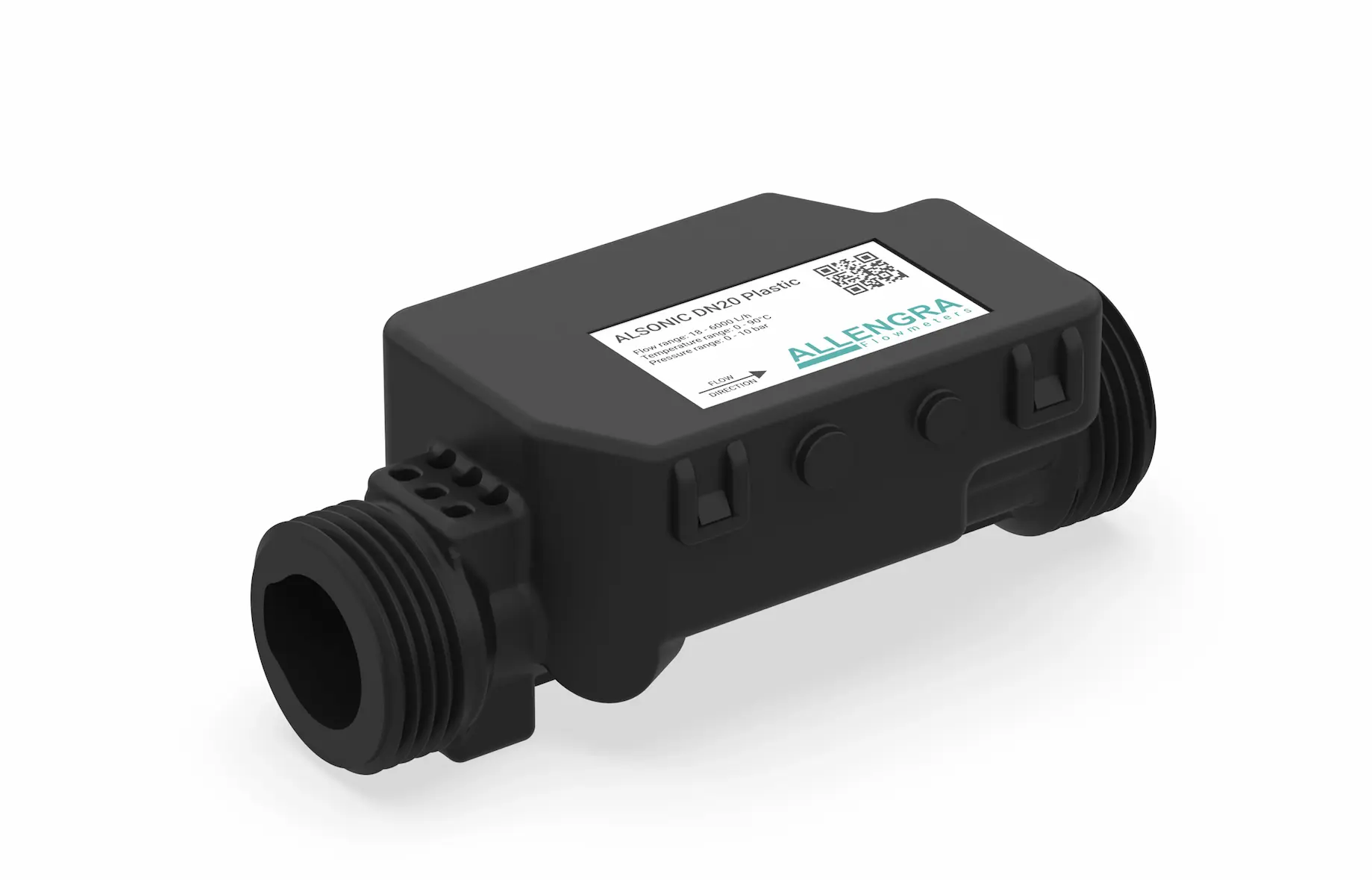
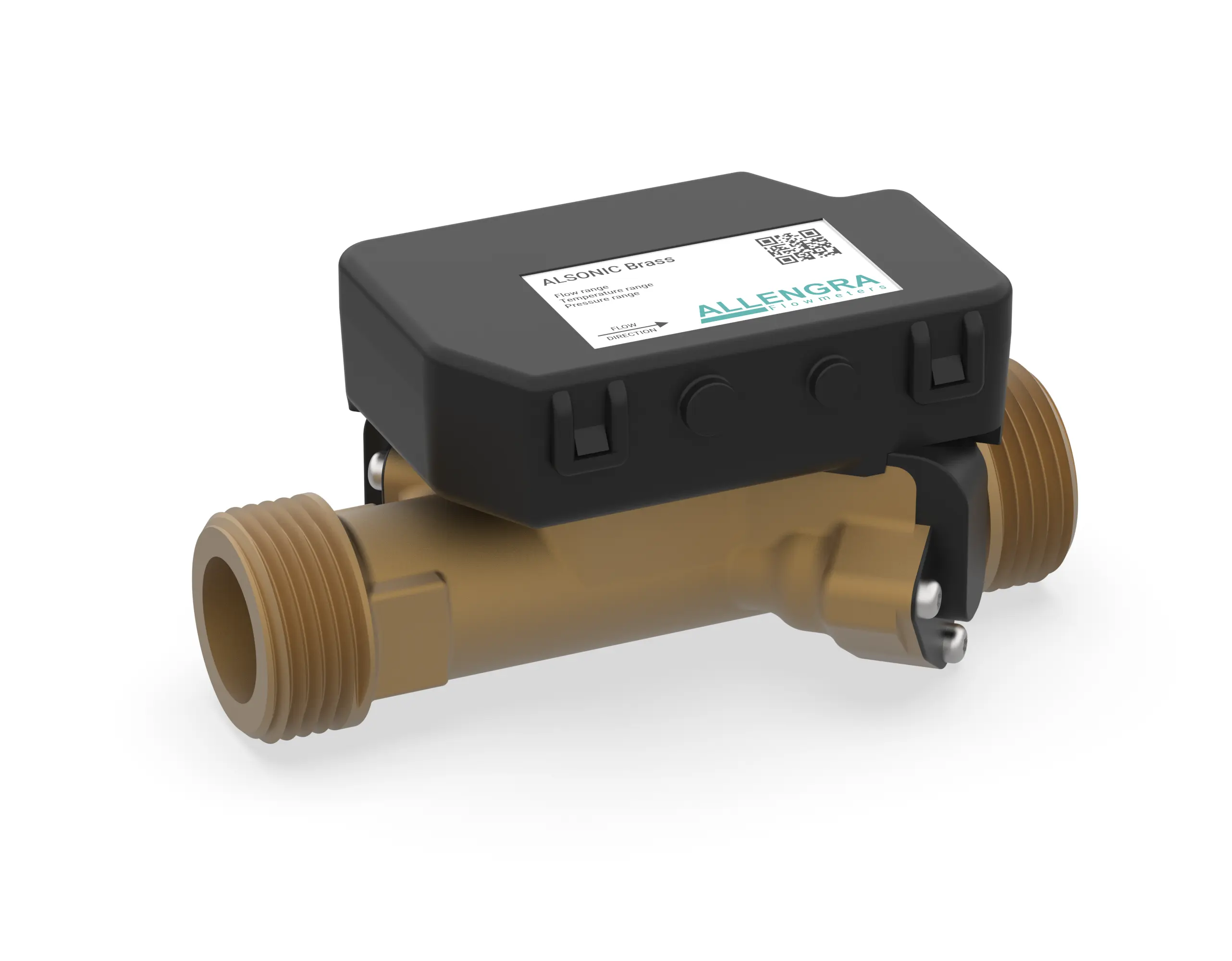
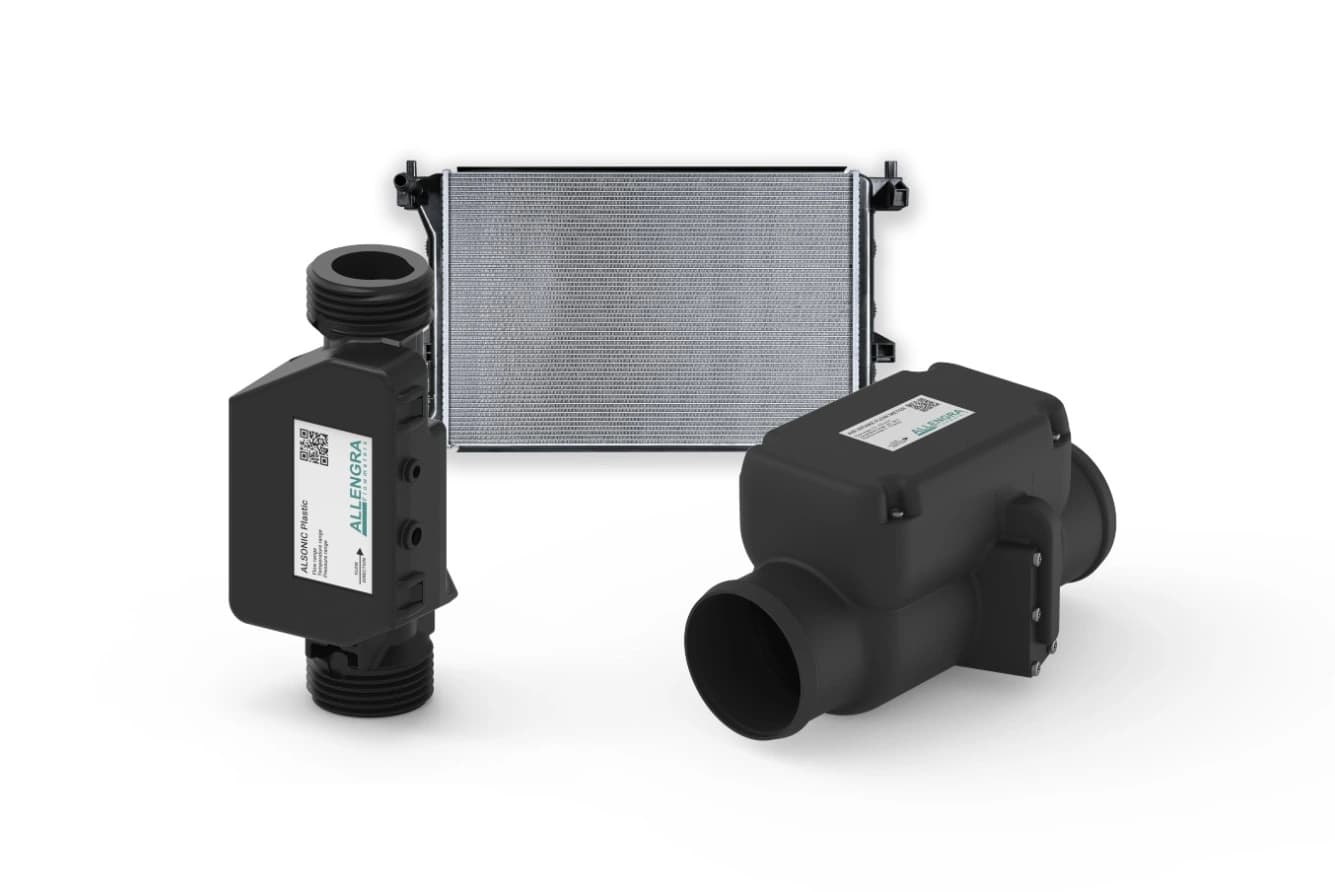
This is where Allengra comes with a simple yet very effective solution, a versatile ultrasonic flow meter.
How does it work?
An ultrasonic flow meter uses ultrasonic waves (very high frequency sounds) to measure the flow of a liquid without direct mechanical contact with it. Unlike traditional meters, it operates based on the 'time of flight' principle, measuring the time it takes for ultrasonic signals to travel between sensors to determine the fluid's velocity.

How can this flow meter solve all of these major challenges that the automotive domain faces right now?
1. Performance. When it comes to performance, the flow meter knows exactly how much coolant needs to be used, and it can optimize the cooling method depending on the task. Stable temperature, greater efficiency, and lowered energy consumption.
2. Safety. Early failure detection can prevent overheating by gas bubble detection, integrated temperature, and abnormal flow detection. The system can enter a limp mode or shut down correctly and safely.
3. Reliability. With ±2% accuracy and a wide range (9 L/h – 60,000 L/h), it can detect degradation, over time deposits in the radiator, decreased pump performance, and fluid aging. Instead of repairing or replacing a certain component in the cooling system, our flow meter predicts the problem before it happens.
4. EV & Batteries. In batteries, constant and uniform flow is required; small differences can affect the lifespan of a battery. The flow meter comes in to help with automatic compensation (glycol dependent) for thermal uniformity and temperature + flow synchronization for preventing cell degradation.
5. Controlling the quality of the liquid. The glycol concentration monitoring function is a great advantage because low levels of glycol increase the risk of freezing, and high levels of glycol create poor heat transfer. With automatic measurement, the system self-compensates and maintains optimal performance.
Our ultrasonic flow meter transforms a “passive” cooling system into an intelligent and real-time controlled one based on very precise engineering.
Allengra is a development company, and we can customize the parts in order to fit them on production cars. Collaborating with Original Equipment Manufacturers (OEMs), we are able to meet high standards and create an entire ecosystem around our precise sensors using our expertise in Time Of Flight technology to create a reliable solution that has no moving parts.
No moving parts means better reliability, precision, durability, and modifiable design in order to meet any manufacturer’s requirement.
Why would a company benefit from using ultrasonic flowmeters like ALSONIC?
Firstly, the car’s cooling system would benefit a lot from using our flow meter because it provides a type of information that you normally don’t have:
· How the fluid is actually flowing through the system.
· The quality of the fluid
· Delays
· Oscillations
Not just what temperature it is.
In most cooling systems, engineers rely on temperature and sometimes pressure sensors, but these only show the effect (i.e., something is heating up), not the cause. With a flow meter, you can see directly if there is insufficient flow, blockages, or uneven distribution, which makes diagnostics much faster and more accurate.
It also becomes much easier to evaluate how well the coolant is distributed across the system. Modern cooling architectures often have multiple branches, and even if the total flow is correct, some areas may still be under-cooled. Flow measurement helps identify these imbalances, which are not always visible through temperature data alone, since temperatures tend to equalize and can hide localized issues.
It is also essential for calibrating modern electronically controlled systems. In today's cars, including high-volume models, water pumps and valves are controlled by software. To calibrate them correctly, you need to know exactly what flow rate results for each command. Without this information, adjustments are less precise and can lead to either unnecessary energy consumption or insufficient cooling.
Saving time would also be one major advantage because the flow meter can detect early problems during the tests. For example, if air enters the system or a radiator starts to clog, the flow rate changes immediately, even before the temperature rises dangerously. This allows engineers to identify component degradation early, without waiting for a major failure.
Finally, flow measurement gives a clearer picture of how components like pumps actually perform in real conditions. Instead of relying only on theoretical data, engineers can see how much flow is truly delivered under different operating scenarios, how performance changes over time, and whether the system is operating efficiently.
To conclude, our flow meter adds a completely new dimension to testing. Instead of knowing „how hot things are,” the flow meter can help engineers understand more easily how heat is actually being transported through the system.
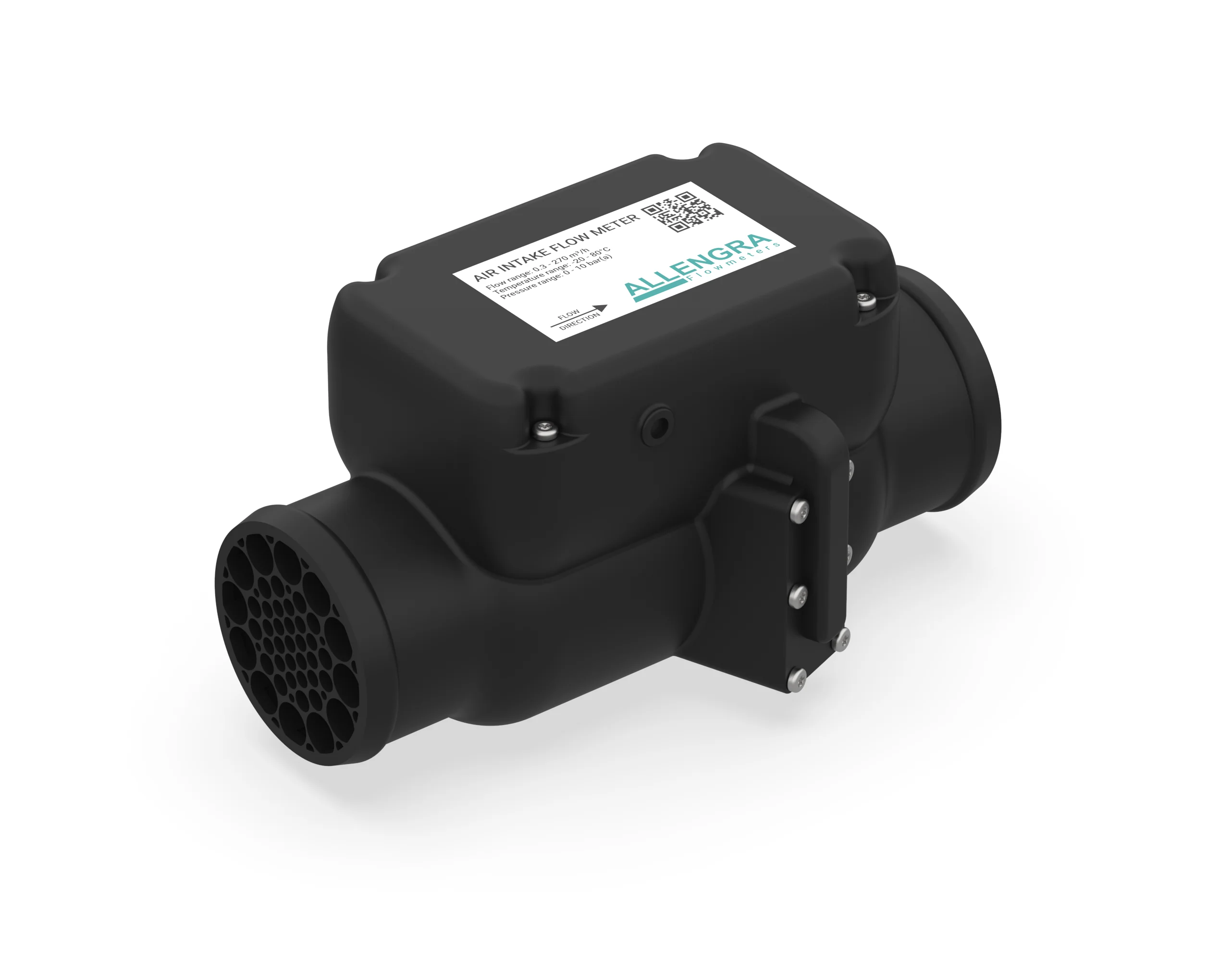
To maximize efficiency and problem-solving, there is a need to understand what goes into the car’s cooling system, for example, the air. Here, we can also include another key component to a car, more exactly, an Air Intake Flow Meter.

How does it work?
This specific type of flow meter is a high-precision instrument that uses sound waves rather than mechanical parts or heated wires to measure air. Because it contains no moving parts, it is incredibly durable and resistant to the "dirty" air often found in automotive and industrial intakes.
How can it help the car’s cooling system?
1. Efficiency in High-Pressure Turbocharged Engines.
As mentioned earlier, modern "downsized" engines use high-pressure turbochargers to get more power out of smaller displacements. Our meter's ability to measure from 0.3 to 270 m³/h allows it to track air at both a tiny idle and a full-throttle turbo boost. Also, with a high rating up to 10 bar, it won’t crack or leak under the intense pressure found in heavy-duty machinery or high-performance cars.
2. Faster Development & Calibration.
Automotive engineers spend years "mapping" engines—telling the computer how to react to different air conditions. Instead of installing a separate temperature sensor, a separate pressure sensor, and a separate flow meter, engineers could use this all-in-one unit. Also, our air intake flow meter simplifies the wiring harness and reduces the number of failure points in the vehicle, lowering warranty costs for manufacturers.
3. Real-Time Emissions Compliance.
Stricter global emissions standards (like Euro 7) require cars to be "clean" not just in a lab, but in the real world. The core of the device measures the actual velocity of the air. By sending ultrasonic pulses upstream and downstream, it determines the precise volume flow in real-time, unaffected by mechanical wear or air density. To convert this volume into mass flow, the integrated PT1000 and ceramic pressure sensors calculate the air density using the Ideal Gas Law. By combining the ultrasonic velocity with the pressure and temperature data, the vehicle can calculate the exact number of oxygen molecules entering the system. This allows the ECU to adjust tuning instantly for changes in altitude (pressure) or ambient heat, keeping emissions low whether the car is in the Alps or the Sahara Desert.