1. Why Flow Meter Choice Matters in Data Center Cooling
Data center cooling loops have a few characteristics that make technology selection more important than in a standard HVAC application.
Uptime requirements are high. A flow meter that needs an annual service or that fails in year three isn't just a maintenance cost; it's a potential system shutdown or, at a minimum, a data gap during replacement. Cooling loops often can't be isolated without affecting active IT equipment.
Fluid compositions vary. Primary loops frequently run glycol-water. Secondary loops in direct liquid cooling systems often run deionized water, which is aggressive toward certain materials. Some systems use specialty dielectric fluids. A meter that works well in clean water may corrode, clog, or misread in these environments.
Accuracy requirements are real. Thermal energy calculation, the number that feeds PUE reporting, SLA verification, and operational optimization, depends directly on flow accuracy. A meter that reads 3% high gives you systematically wrong energy numbers for the life of the installation.
Pressure margins can be tight. Variable-speed pump systems are optimized to deliver the minimum pressure needed for adequate flow. A flow meter that adds 0.5 bar of pressure drop either forces the pump to work harder or reduces the available flow margin. Neither is free.
2. How Mechanical Flow Meters Measure
Mechanical flow meters extract energy from the flow stream to drive a measurement mechanism. The specific approach varies by type:
Turbine meters place a bladed rotor in the flow path. Fluid velocity spins the rotor; the rotation rate is proportional to flow. They're accurate at rated flow conditions and provide a simple pulse output.
Vortex meters measure the frequency of vortices shed behind an obstruction (the bluff body) placed in the pipe. Vortex shedding frequency is proportional to velocity, according to the Strouhal relationship. No rotating parts, but still an intrusive obstruction in the flow path.
Differential pressure meters, orifice plates, Venturi tubes, and flow nozzles create a known pressure drop and infer flow rate from it. Straightforward physics, but the permanent pressure loss is an inherent feature of the measurement principle.
Positive displacement meters trap and count fixed volumes of fluid per cycle. Very accurate at low flow rates, but they have moving parts and are sensitive to viscosity changes.
What all mechanical types share: they introduce something into the flow path, and that something either moves, obstructs, or both. Those are the two characteristics that drive most of the practical differences in a data center cooling application.

3. How Ultrasonic Time-of-Flight Flow Meters Measure
Ultrasonic time-of-flight meters work by measuring how long it takes a sound pulse to travel between two transducers mounted on the pipe, one upstream, one downstream.
A pulse sent downstream (with the flow) travels slightly faster than one sent upstream (against the flow). Total transit time across the pipe is measured in microseconds; the upstream/downstream difference is much smaller than the absolute transit time, and it is directly related to fluid velocity. Measure the transit time difference accurately enough, and you have a precise flow reading. Integrate over the pipe cross-section with a multi-path design, and you have a meter that handles non-ideal flow profiles without needing long straight pipe runs.
What makes this genuinely different from mechanical measurement is what it doesn't do. There's nothing in the flow. No rotor, no bluff body, no orifice. Transducers clamp to the outside of the pipe or are mounted flush with the pipe wall — either way, the measurement is contactless. The fluid never touches the sensing element. The flow path is unobstructed.
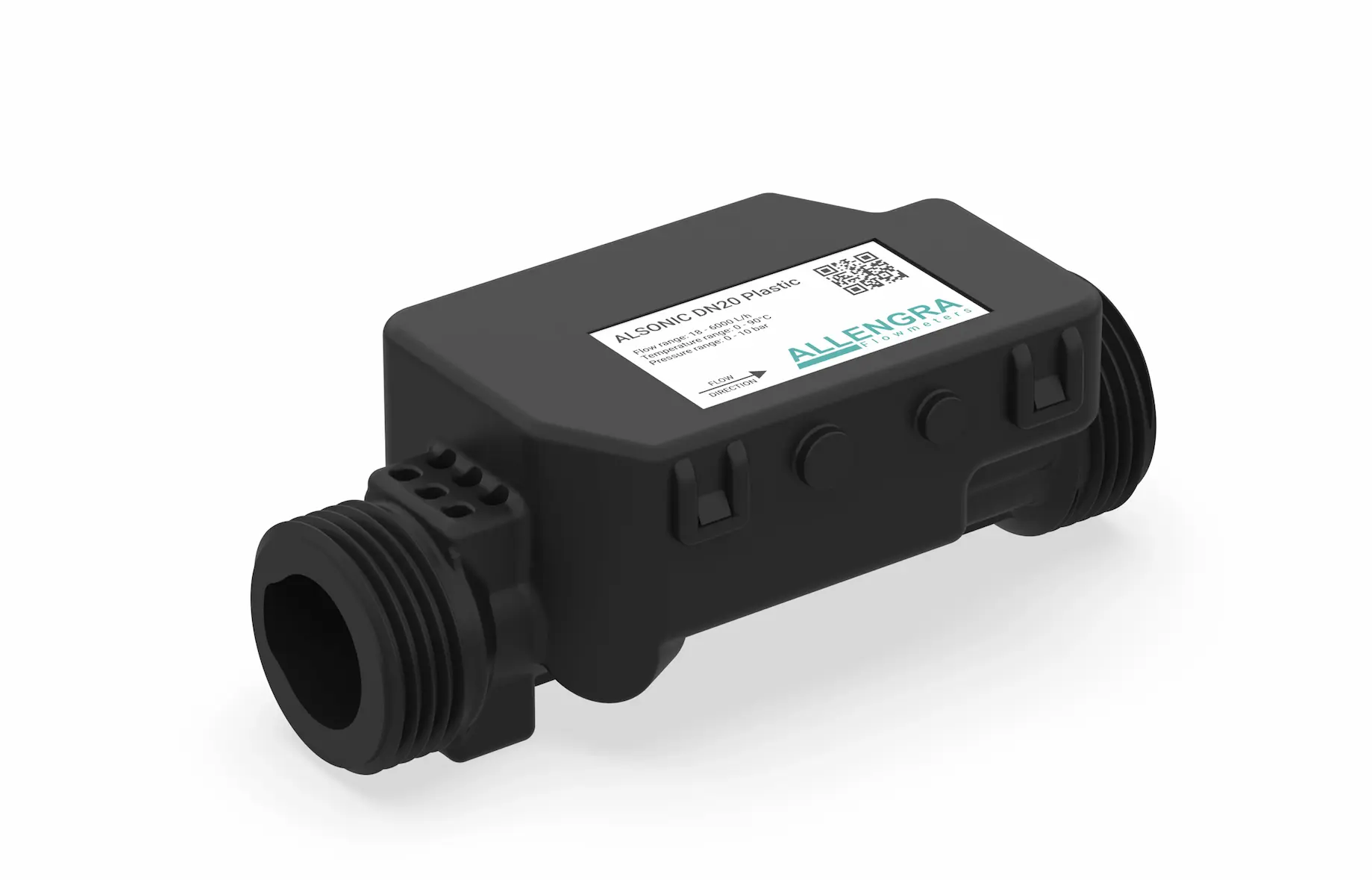
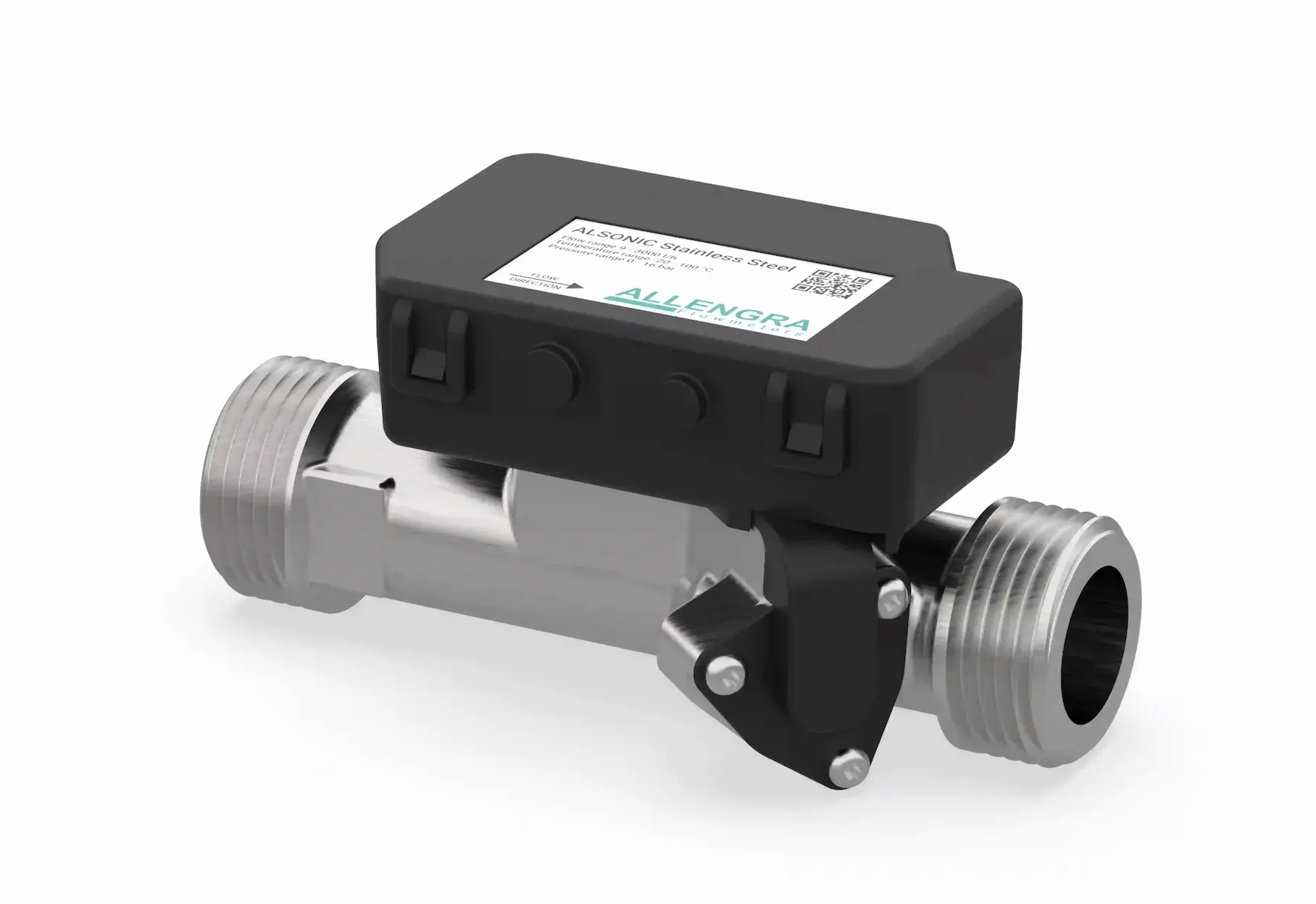
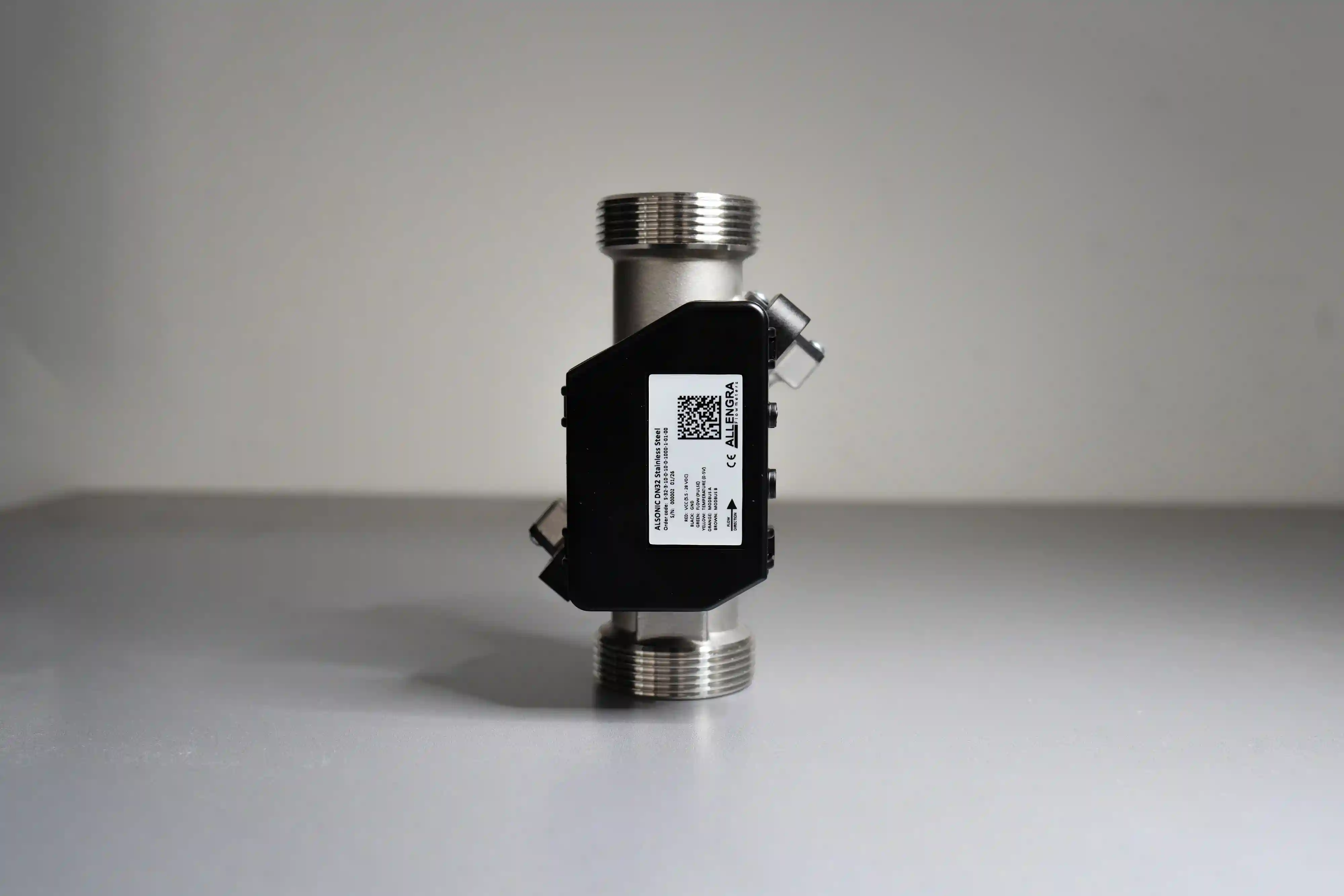
Physics also gives you more than just flow. Sound velocity in a fluid is a function of fluid composition and temperature. That means an ultrasonic meter can measure glycol concentration, detect the presence of gas bubbles (which change the acoustic response dramatically), and flag fluid property changes, all from the same measurement that gives you flow rate. This is what the ALSONIC from Allengra does: the time-of-flight measurement carries fluid property information alongside the flow reading, and the electronics interpret both.

4. Pressure Drop and Pump Energy Implications
This is where the difference between technologies becomes a direct operating cost.
Every obstruction in a pipe creates a pressure drop. Pressure drop has to be overcome by the pump. More pump work means more energy.
Pressure drop is meter- and velocity-specific, but as an order-of-magnitude guide: turbine meters in a 100 mm chilled-water line at typical velocities (1–3 m/s) sit in the 0.05–0.3 bar range under most published curves; orifice plates add a permanent loss of roughly 50–80% of the measured differential pressure, which can be 0.3–1.5 bar at low beta ratios.
An ultrasonic low-pressure drop flow meter with no intrusive element adds nothing effectively. The signal is extracted acoustically; the fluid doesn't know the meter is there. That means the pump curve isn't affected, the system pressure doesn't need to be set higher to compensate, and VFD savings aren't partially erased by the measurement hardware.
For a chilled water system running continuously, even a 0.3 bar reduction in pump head at constant flow translates to measurable annual energy savings. The math depends on flow rate, pump efficiency, annual run hours, and the pressure-drop difference between the two meter options.

5. Maintenance and Wear Considerations
Mechanical meters wear because they have moving parts or fluid-wetted components subject to corrosion and fouling.
Turbine rotor bearings. They tend to wear over time, particularly in fluids with low lubricity or in deionized water where there's no dissolved content to provide even minimal lubrication.
Vortex meters have no rotating parts but have a bluff body that can accumulate fouling, particularly in systems with particulate contamination or biological growth. A partially fouled bluff body changes the vortex shedding characteristics and shifts calibration.
Orifice plates and other DP meters are mechanically simple but require impulse lines and differential pressure transmitters that can block, freeze, or corrode. In glycol systems, impulse line maintenance is a real consideration.
Ultrasonic meters with no wetted moving parts have no equivalent wear mechanism. There's nothing to corrode in the flow stream, nothing to foul, nothing to replace on a schedule. A maintenance-free flow meter.
For data center applications where cooling loop isolation means IT risk, eliminating scheduled maintenance on flow meters is a real operational benefit.
6. Coolant Compatibility and Fluid Quality
Data center cooling loops use a range of fluids, and not all flow meter types handle all of them well.
Glycol-water. Standard in primary chilled water loops for freeze protection. Most mechanical meters handle standard glycol concentrations, but the glycol percentage affects viscosity, which affects turbine and DP meter calibration. An ultrasonic meter measuring sound velocity can determine glycol concentration directly and compensate for it in the energy calculation. The ALSONIC lineup does this natively. A turbine meter calibrated at a 30% glycol concentration will have a calibration shift if that concentration drifts.
Deionized water. The standard fluid in direct liquid cooling secondary loops. Deionised water is aggressive toward most metals because the absence of dissolved ions drives ion exchange at the wetted surface; iron and copper corrode quickly, and even some stainless alloys see measurable attack over a multi-year service life. Turbine bearings are particularly vulnerable. Ultrasonic measurement eliminates the wetted-metal concern for the flow sensor itself; the transducer housing can be specified in compatible materials without the bearing and rotor issue.
Specialty dielectric fluids. Used in immersion or some single-phase liquid cooling systems. These often have higher viscosity than water and can be challenging for turbine meters, which have a velocity-dependent response curve that shifts with viscosity. Ultrasonic time-of-flight is relatively insensitive to viscosity, making it more reliable across fluid types.
Fluid cleanliness. In a real installation, even systems with good filtration will see some particulate over time. Turbine rotor bearings accumulate deposits. Orifice plates collect debris on the upstream face. An unobstructed ultrasonic meter has no collection point.
7. Digital Outputs and Integration
Both mechanical and ultrasonic meters can provide pulse outputs for flow totalization. The difference is in what else they can provide.
A turbine or vortex meter gives you the flow rate. That's it, the physics of the measurement doesn't support anything else.
An ultrasonic meter's measurement contains additional information. Sound velocity in the fluid, signal attenuation, and the acoustic response pattern all carry data about fluid composition, gas content, and flow profile. A meter that extracts and communicates this the way the ALSONIC does gives you flow rate, fluid velocity profile, glycol concentration, bubble detection status, and signal quality indicators, all from a single measurement point.
For integration, the ALSONIC sensors support Modbus RTU for BMS and DCIM integration, IO-Link for OEM machine-builder applications (which carries full diagnostic data on a single cable alongside the process value), LIN-Bus for embedded CDU controller integration, and standard analog and pulse outputs for legacy systems. That breadth matters when you're specifying a meter that needs to work in a new CDU design and also in an existing building management system.
Mechanical meters typically output pulse or 4–20 mA. Protocol support is less consistent and rarely includes diagnostic outputs.
8. When Each Technology Is Appropriate
Mechanical meters still have a place. Where they fit and where they do not is the practical question; the rest of this section gives the rule of thumb.
Use an ultrasonic time-of-flight meter when:
Pressure drop budget is tight (VFD systems, long distribution loops)
The fluid is deionized water or a fluid aggressive to bearings and metals
Maintenance access is limited, or maintenance interruptions carry IT risk
You need fluid property data alongside flow (glycol concentration, bubble detection)
The installation is expected to run 10+ years without service
Integration depth matters: Modbus, IO-Link, or diagnostic outputs are required
The flow range is wide, including low-flow conditions where turbine meters become inaccurate
Mechanical meters may still be appropriate when:
The application is a low-stakes subloop where accuracy requirements are relaxed
Budget is very constrained, and digital integration isn't required
The installation has easy isolation valves, and maintenance windows are available
Fluid is clean, stable, standard water with no glycol variation concerns
Straight pipe runs and installation space are sufficient, and pressure drop is not a concern
For primary plant metering, CDU secondary loops, and any application where the flow data feeds energy reporting or BMS control, the case for ultrasonic is strong. For a simple monitoring point on a non-critical branch loop where ±5% is acceptable, and maintenance is easy, a mechanical meter may be adequate.
9. Specification Checklist for Cooling Applications
Before selecting a flow meter technology for a cooling loop, work through these:
Fluid composition confirmed water only, glycol-water (what concentration?), DI water, dielectric fluid?
Operating flow range minimum and maximum, and what accuracy is required at minimum flow
Pipe size and schedule at measurement point
Available straight pipe run upstream and downstream
Pressure drop budget: What can the system afford at maximum flow?
Required flow accuracy ±0.5%, ±1%, or ±2%? Is this for billing/reporting or operational monitoring?
Required outputs — pulse, 4–20 mA, Modbus, IO-Link, LIN-Bus?
Fluid temperature range at the measurement point
Maintenance access: Can the pipe be isolated? How often is a maintenance window feasible?
Installation lifetime expectation: 5 years, 10 years, longer?
Do you need fluid property data alongside flow (glycol concentration, bubble detection)?
Calibration traceability requirements MID Class 2 or equivalent for formal energy reporting?
Material compatibility verified for all wetted or transducer-contact components
Budget for total cost of ownership, not just purchase price, including maintenance, spare parts, calibration intervals
For most data center cooling applications, particularly anywhere DI water, glycol variation, or tight pressure margins are involved, ultrasonic time-of-flight is the more robust choice. Allengra's ALSONIC sits in this category: contactless and wear-free, with sound-velocity-based fluid-property measurement and the Modbus / IO-Link / voltage / current integration options that plant rooms and CDUs typically need.